You can find all our articles and past events
Free Articles | Inside PMO | PMO Conference | PMO Book Shelf
The Programme Office: What It Is, What It Does, and Who Works Within It
The Programme Office is one of the most common types of PMO you’ll come across. It appears in organisations of all shapes and sizes and yet… it’s also one of the least consistently understood.
Ask a room full of PMO professionals what a Programme Office is, and you’ll get a mix of answers – some aligned, some wildly different, and some based purely on what their organisation happens to call it.
That’s exactly where this session started.
While the term “Programme Office” gets used a lot, it doesn’t always mean the same thing. In some places it’s a clearly defined part of programme delivery. In others, it’s a label that’s been inherited or never really explained.
The interesting thing that unfolded in the session was there isn’t one single definition – but there is a clearer way to think about it.
Recorded Session
Presentation Deck
Download the DeckKey Insights
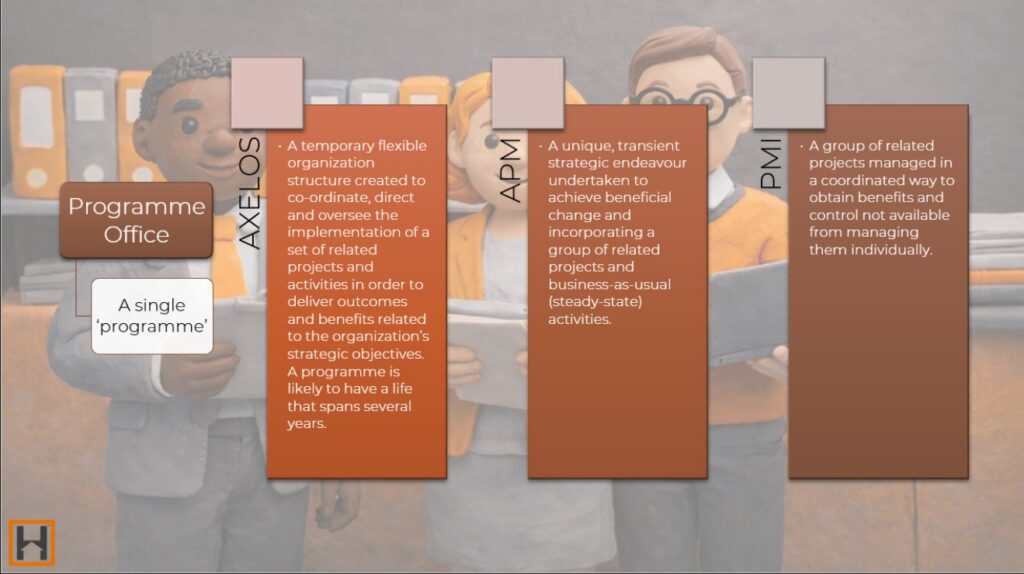
So… what is a Programme Office?
At its simplest, a Programme Office exists to support the coordination and delivery of related work that’s aiming to achieve a bigger outcome.
Depending on the organisation, a Programme Office might be:
- Supporting a single large programme
- Coordinating multiple projects
- Sitting somewhere between programme and portfolio level
As one of the key themes in the session highlighted – sometimes what the textbook says doesn’t necessary match the reality. In fact during the session, we asked the question in the chat:
“Is anyone thinking – they might work in something called a Programme Office – but actually… it might not be?”
That certainly got a lot of people thinking about their current situation.
The naming problem
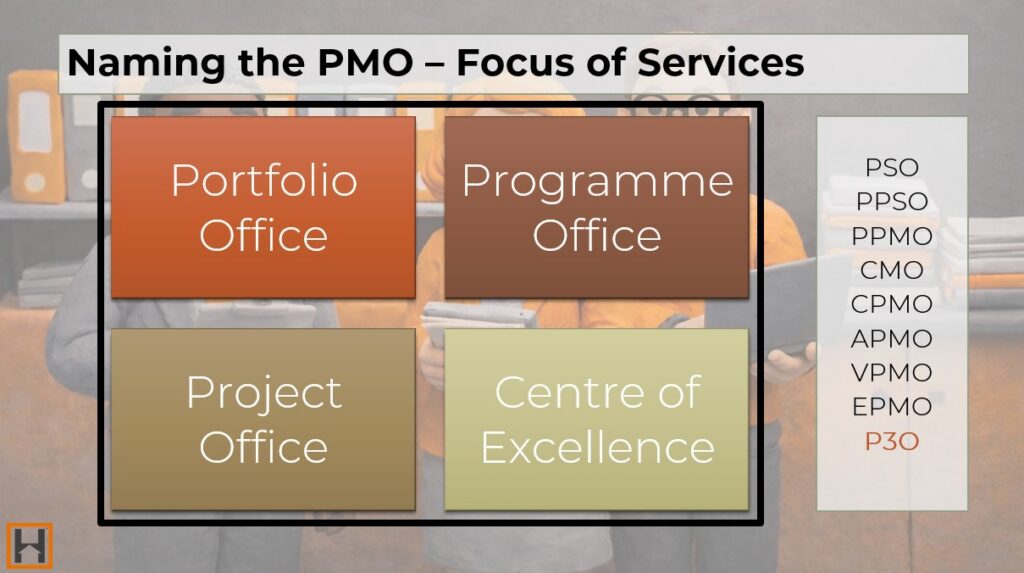
One of the strongest threads through the session was around naming.
We saw how “Programme Office” sits alongside a whole mix of labels – Portfolio Office, Project Office, Centre of Excellence – each implying something slightly different about purpose and authority.
But in practice?
- Names are often legacy-driven
- Sometimes chosen because they make sense to senior stakeholders
- Occasionally… just never revisited
“It’s the old thing of using language the senior team will understand.”
The risk is that the name starts to shape expectations:
- Are you there to control or support?
- Are you focused on delivery, governance, or insight?
- Are you operating at project, programme, or portfolio level?
If those expectations aren’t clear, the Programme Office can end up trying to be all things to all people.
What does a Programme Office actually do?
We broke this down into three key areas:
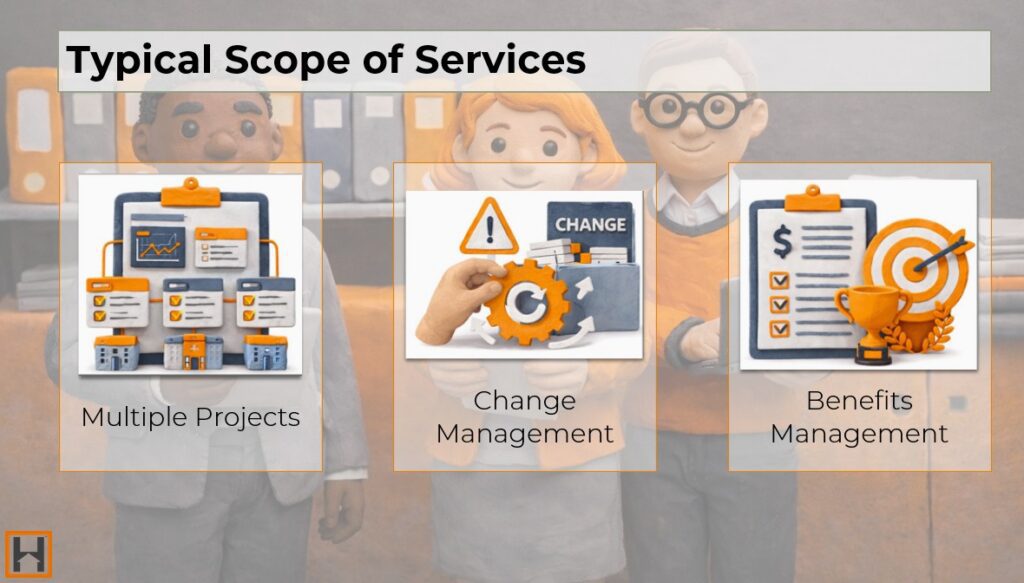
1. Supporting multiple projects
This is the bread and butter:
- Planning and scheduling
- Risk and issue management
- Reporting and dashboards
- Resource management
- Governance and assurance
You’ll recognise most of this from core PMO services.
2. Change management
This sparked a really interesting discussion.
Programme Offices often end up doing change management work… even if it’s not formally recognised.
- Stakeholder engagement
- Communications
- Training and readiness
- Transition into business-as-usual
“Feel like we just get on with it in the PMO (budget constraints for Change Manager).”
So while it might not always sit in the job description, it’s happening.
3. Benefits management
This one got a lot of nods in the chat.
In theory, Programme Offices play a key role in:
- Benefits mapping
- Benefits tracking
- Maintaining registers and profiles
In reality?
- Benefits often aren’t tracked beyond delivery
- There’s limited handover to BAU
- Financial benefits tend to dominate
“Assumption that project/programme is complete therefore benefits must have been achieved.”
You’ll want to watch the session in full to further gain some really great insights from this part – jump to the 9 minute mark!
Who works in a Programme Office?
One of the things the session highlighted is that Programme Offices aren’t just made up of “PMO people” doing generic coordination work. There’s usually a blend of generalists and specialists, and that mix tells you a lot about how mature or broad the function really is.
At the core, you’ll typically find PMO generalists – the people keeping everything moving:
- Coordinating reporting cycles
- Managing risks and issues
- Supporting governance and decision-making
- Keeping plans, actions, and dependencies aligned
But around that core, Programme Offices often bring in more specialist roles, depending on the scale and complexity of the work.
From the session, common specialist roles included:
- Planners – often seen as a discipline in their own right, focused on integrated plans, dependencies, and critical paths
- Reporting and data specialists – turning delivery data into meaningful insight
- Resource management specialists – managing capacity, demand, and allocation across projects
- Risk and issue specialists – driving consistency and visibility across the programme
- Benefits specialists – supporting tracking, mapping, and realisation (where organisations are doing this well)
- Communications and engagement roles – especially where the Programme Office is supporting change
What was interesting from the discussion is that not every Programme Office has all of these roles formally defined. In many cases, people are wearing multiple hats.
You might have:
- A PMO Analyst doing reporting and risk management
- A Planner doubling up as a resource manager
- Or a PMO Lead quietly covering off change and benefits work without it being explicitly recognised
A Programme Office isn’t defined by job titles – it’s defined by the capabilities it brings together. The more intentional you are about those capabilities, the clearer the value becomes.

The Open Discussion
 One of the most valuable parts of the session was the open discussion. A few themes kept coming up:
- People working in a “Programme Office” but actually operating at portfolio level
- Confusion at senior levels about the difference between project, programme, and portfolio
- Structures driven more by history than design
A neat summary from the chat captured it well:
- Project = doing the work
- Programme = coordinating related work
- Portfolio = choosing the right work
Simple. But not always reflected in how organisations are set up.
Try This in Your PMO
If you’re sitting in (or alongside) a Programme Office, here are a few practical things you can do straight away:
Sense-check the name vs reality
Take a step back and look at what your team actually does day to day.
- Are you coordinating a single programme, or multiple initiatives?
- Are you making decisions about prioritisation and investment (portfolio-level work)?
- Or mainly supporting delivery at project level?
If there’s a mismatch, don’t rush to rename – but be clear on how you describe your role to others.
Clarify expectations with stakeholders
Have explicit conversations with key stakeholders about what your Programme Office is there to do.
- Where do you provide support vs where do you provide control?
- What decisions are you informing, and which ones are you influencing?
- What does “good” look like from their perspective?
This avoids the classic trap of being seen as either too controlling or not adding enough value.
Define where you sit in the bigger picture
Be really clear how your Programme Office fits into the wider PMO landscape.
- How do you interact with project-level teams?
- Where does a portfolio or enterprise PMO sit (if there is one)?
- Where do responsibilities start and end?
Even a simple visual can help reduce confusion across the organisation.
Spot the gaps and overlaps
Once you’ve mapped everything, look for:
- Things no one is properly owning (often benefits or change)
- Areas where multiple teams are duplicating effort
- Services that exist but aren’t adding much value
This is where you can start evolving the Programme Office in a more intentional way.
Deepen Your Knowledge
We’ve created a worksheet which you can download and use to deepen your knowledge and test your understanding.
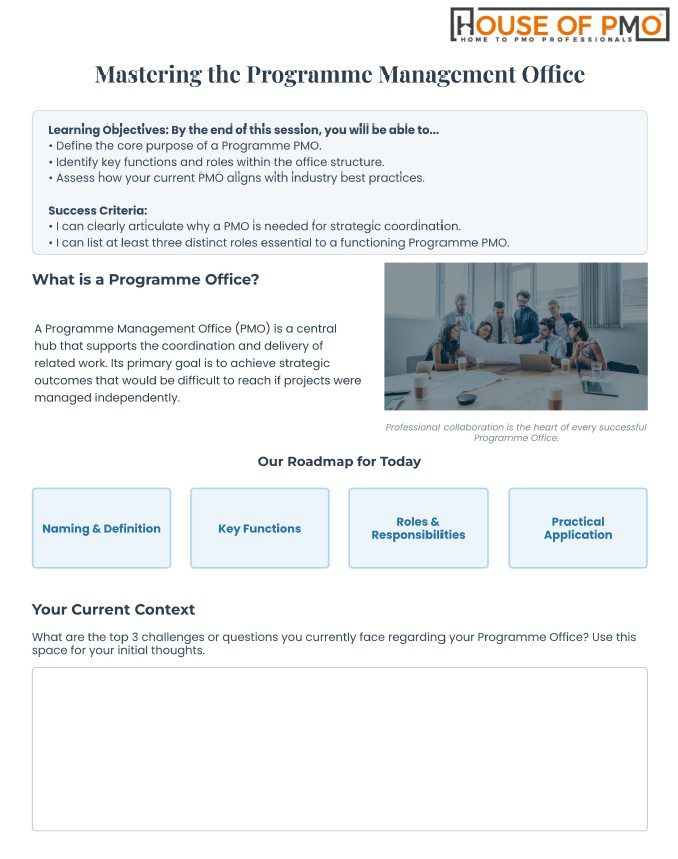
We’ve also created some guidance to help you work though the worksheet.[Download here]