You can find all our articles and past events
Free Articles | Inside PMO | PMO Conference | PMO Book Shelf
AI in the PMO: What Changes When We Start Using It for Real?
AI in the PMO: What Changes When We Start Using It for Real?
 A milestone due next month becomes a milestone already delivered, the executive summary reads well, unfortunately, it’s wrong. That’s certainly one of the downsides to AI!
That was one of the experiences shared at our Edinburgh panel evening. It captured the tension running through the conversation: AI can make PMO work quicker and open up new possibilities, but someone still needs to understand what it has produced.
Hosted by Computershare, AI in the PMO: Useful, Uncomfortable and Unavoidable? brought together practitioners with different experiences of using AI. Some were experimenting, others were building specialist agents, and several were working through the tricky questions that come with adoption.
The discussion moved between enthusiasm and caution, with plenty of examples of both. What emerged was a practical conversation about how PMOs can use AI while retaining the judgement, trust and accountability their work depends on.
Moving beyond meeting notes
“Using the agents to spot things that the humans ultimately may have missed.”
Meeting transcription and action tracking are familiar starting points. Things like research, drafting communications and pulling information together also featured in the discussion.
An audience contribution offered a particularly relatable example: using AI to take the heat out of an email. When a message provokes an irritated response, a little help with the wording can make the next exchange more constructive. There’s certainly been less inflamed relations as a result!
The panel also explored applications that reach further into PMO work. Specialist agents were described with memorable names, including Ruby Risk, Frank Finance and Carol Coordinator. Their roles included reviewing risks, analysing financial information and bringing findings together for reporting.
Another area of interest was moving beyond retrospective reports to explore potential missed milestones and budget problems. These were described as emerging uses, with experimentation still under way.
For PMOs, that opens up an interesting question. Once AI helps with preparing information, how much more attention can we give to understanding what it means and what needs to happen next?
Write a fictional project risk and ask: “What assumptions are we making? What might we have missed? What questions would help us assess this properly?” Pick one useful question to add to your next risk review.
Reliable AI starts with reliable data
“AI is just going to amplify your problems.”
 The conversation repeatedly returned to data. And something we’ve covered a lot at the House of PMO because it is the cornerstone of what good PMOs do!
PMOs know the difficulties: information spread across documents and systems, inconsistent definitions, reports updated at different times, and uncertainty about which version to trust. Adding AI does not resolve those issues automatically.
One concern raised was whether an AI tool had actually accessed all the information needed to answer a question. A plausible summary might still represent only part of the picture.
The panel discussed bringing relevant information into a structured, governed source so that its quality and coverage can be understood. That means knowing where information comes from, how current it is and who owns it.
There is a useful PMO contribution here. Improving data readiness may be less eye-catching than launching an agent, but it gives those applications a stronger foundation.
Before asking what AI can tell us about a portfolio, we need confidence in the information it will use.
Choose a figure from your latest PMO report. Can you identify its source, when it was updated and who owns it? Does it match the source? Fix one gap before experimenting with AI analysis.
Faster drafting still needs time for checking
“You’ve got to be able to rely on that information that’s been summarised for you.”
The milestone example showed why verification from a human really matters. A panel member described AI-generated reporting that presented planned delivery as completed delivery, changing the meaning of the information being shared.
Meeting notes raised similar concerns. Names, accents, actions and context can be misinterpreted. A transcript may capture words without accurately capturing the decision or commitment behind them.
There was also a challenge to the expectation that AI-assisted minutes should be distributed almost immediately after a meeting. Drafting may be faster, but checking still requires time.
An agreed review window gives people space to verify the output before it becomes an official record.
That has implications for PMO processes. Who checks an AI-generated report? What do they check it against? Who approves its release?
Those responsibilities need to be clear, particularly when the output will inform senior decisions. The person sharing it must understand it well enough to challenge it.
Take an AI-generated summary and check five statements against the original material. Include a date, an action and a delivery status. Note any changes in meaning. Use what you find to create a short review checklist.

Adoption depends on trust as well as tools
“You have to read the room.”
People bring different expectations to AI. Some are curious, some are sceptical, and some are worried about what it means for their jobs.
The panel discussed the importance of recognising those differences. Recording a meeting or introducing AI-assisted work can affect how comfortable people feel and how openly they contribute. Explaining the purpose and agreeing the approach are part of making it work.
There were also concerns about corporate information being moved into personal AI accounts. Someone seeking a better answer or a quicker result may create a problem for the organisation by using an unapproved environment.
The discussion pointed towards the need for clear boundaries, alongside practical support.
People need to know which tools they can use, what information they can provide and when to seek advice. They also need examples that help them see how AI could improve their work.
Ask a colleague: “What would make you comfortable using AI for one part of your work?” Explore their concerns and identify one task you could test together using an approved tool. Agree how you’ll check the result.

Developing skills without losing PMO expertise
“AI is just a tool, it’s not a replacement mechanism.”
The careers discussion brought some uncomfortable questions into the room.
Panel members described seeing pressure to make PMO teams smaller while expecting those remaining to use AI to cover more work. The conversation challenged whether that approach properly recognised the governance, coordination and judgement those teams provide.
There was also concern about learning. If early-career practitioners have fewer opportunities to do foundational work, how will they develop the understanding needed to spot errors and challenge outputs later?
Building AI skills therefore needs to sit alongside continued development of PMO expertise.
The panel suggested starting with manageable, low-risk activities and learning through practice. Internal coaching, shared examples and advocates who can demonstrate useful applications can help others build confidence.
A practical next step is to choose one approved, low-risk task and test it. Check the result, including the time spent correcting it. Then decide whether it improves the work enough to use again.
The Edinburgh conversation left us with plenty to explore. AI is already finding its way into PMO work. Making that useful will take reliable information, thoughtful adoption and people who know enough to ask difficult questions.
Use a fictional project update. Write your own short summary first, then ask AI to produce one. Compare what each version prioritises, misses or assumes. What does your PMO experience help you spot?
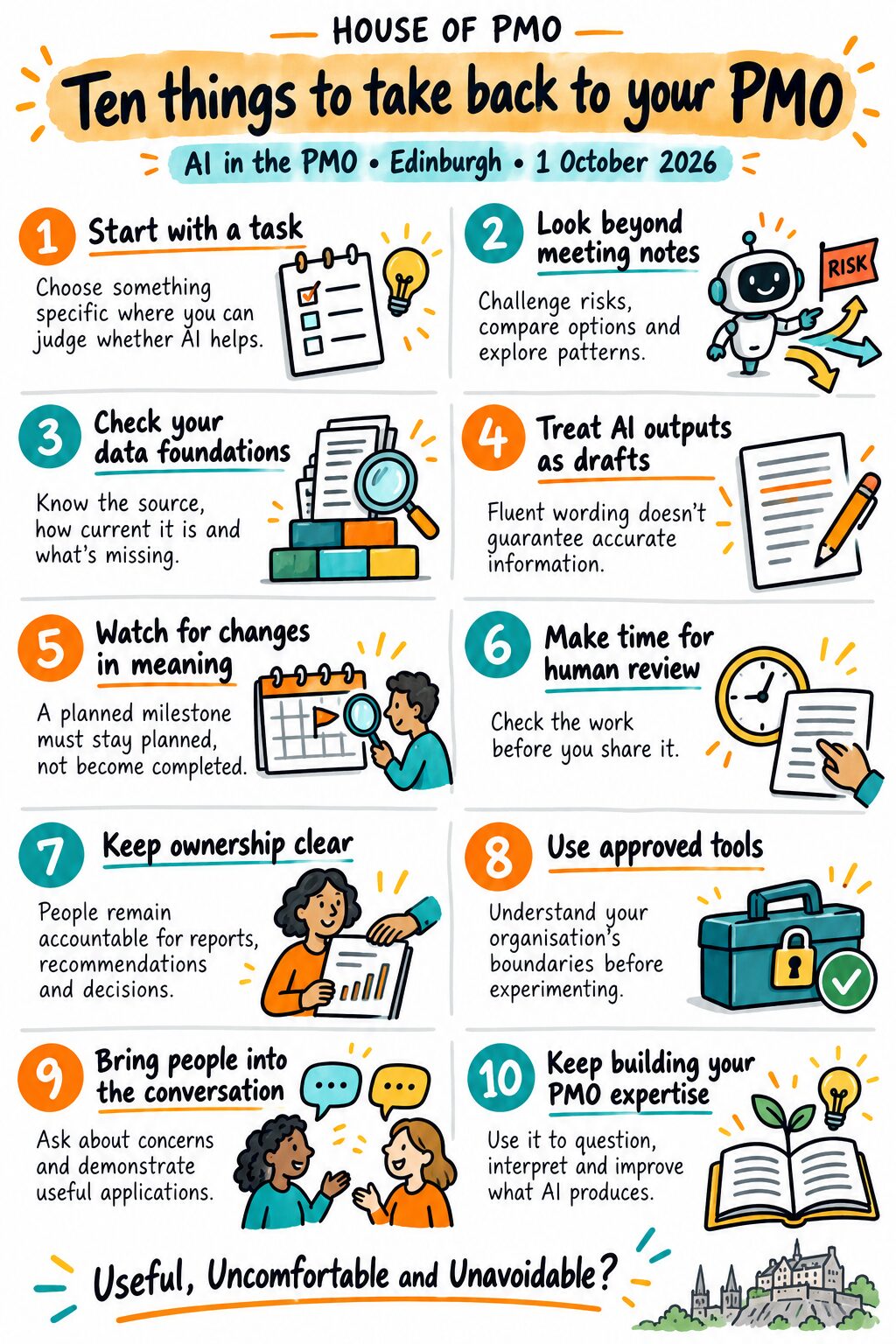
With thanks to our panel: Anthony Reid, Kirsty Lamb, Edward Enejoh, Pedro Oliveira and Simon Sharp; chair Eileen Roden; our hosts Computershare; and everyone who contributed to the discussion.