You can find all our articles for Free Members
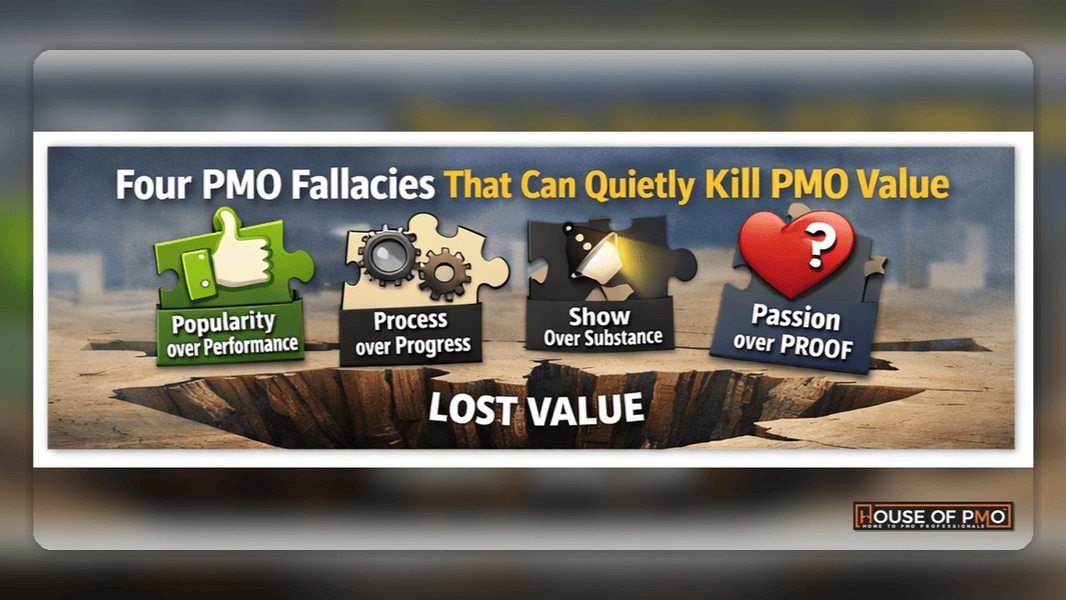
Four PMO Fallacies That Can Quietly Kill PMO Value
Based on articles by Octavius Black CBE and Katie Jacobs.
We often talk about having to demonstrate the value PMOs bring to the organisation. That’s rooted in the fact we’re a support function and support functions get asked (sometimes unfairly): ‘So . . . what do you actually do?’
One of the things we do at House of PMO is look at other industries to see what lessons might have some parallel learnings for PMO. This week I spotted a couple of articles in People Management (Feb–Apr 2026) that felt uncomfortably familiar, one by Octavius Black CBE (co-founder and executive chair of MindGym) and another by Katie Jacobs.
Black’s argument is blunt: HR can become ‘distracted at best, destructive at worst’ when it gets pulled into four fallacies.
As I read them, I thought how easily parallels could be drawn with PMOs. Not because HR and PMO are the same (they’re not), but because they both:
- sit close to leadership decisions
- implement processes across the organisation that have the potential to have a direct impact on company performance
- can accidentally become a magnet for administration, noise, and performative work (work that looks valuable, but doesn’t materially change outcomes)
So, with a PMO lens on, here are the four fallacies as a mirror, not a stick to beat ourselves with.
The four fallacies (PMO edition)
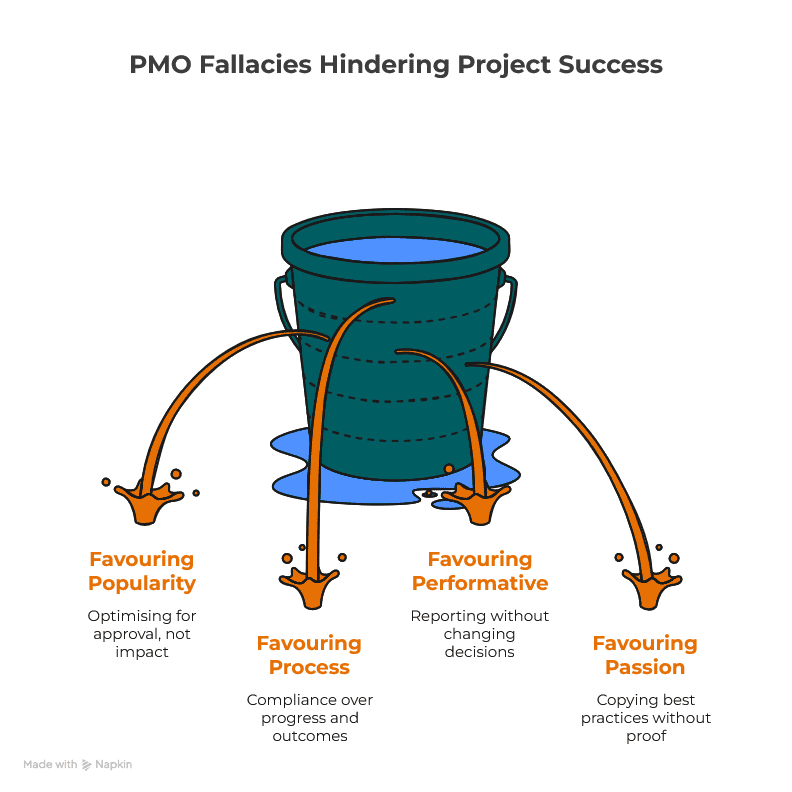
1) Favouring popularity over performance
What it looks like in PMO
- Dashboards designed to be liked rather than used
- RAGs going suspiciously green because nobody wants to be the person who raises the flag
- PMO bending over backwards to avoid challenging optimistic plans, weak governance, or fuzzy benefits because we need to keep stakeholders on side
The uncomfortable reflection
- Are we optimising for approval (people love the PMO!) instead of impact (the PMO have helped the organisation make a better decision)?
Try this: Replace stakeholder satisfaction as the only success measure with decision-quality indicators, such as:
- How many key decisions were supported with evidence?
- How many risks/issues were surfaced early enough to change the outcome?
- How often did governance lead to a meaningful adjustment (scope, sequencing, resourcing, benefits)?
PMO value isn’t being popular. It’s being useful, even when it’s a bit inconvenient.
2) Favouring process over progress
What it looks like in PMO
- We can’t start until the template is completed.
- Gatekeeping that protects the process, not the outcome
- Approvals, checkpoints and paperwork added to manage exceptions or outliers but slowing down everyone else
A little process is a safety rail. Too much becomes treacle.
The uncomfortable reflection
- Are we measuring PMO success by compliance (did they fill it in?) rather than progress (did the work move forward safely and sensibly)?
Try this: Run a 30-day process detox:
- Identify the top 5 PMO processes that consume the most time
- For each one ask: what decision does this enable? what risk does it reduce?
- If you can’t answer clearly . . . simplify, automate, or bin
If your governance doesn’t change decisions or reduce risk, it’s just theatre with a spreadsheet.
3) Favouring performative over profit (or the metrics that matter)
For PMO, the key is connecting PMO effort to the organisation’s actual success measures which might include profit, cash, cost efficiency, risk exposure, customer experience, patient outcomes, service performance, or regulatory results (depending on your context).
What it looks like in PMO
- Busy reporting that looks impressive, but doesn’t change decisions or behaviour
- ‘We’ve launched a new methodology!’ . . . but there’s no adoption plan, no capability uplift, and no change in delivery outcomes
- PMO initiatives are chosen because they look modern (AI dashboards, Agile everywhere) rather than because they remove a real constraint
The uncomfortable reflection
- Are we creating PMO outputs to be seen doing PMO . . . or to help leaders make better calls and improve real results?
Try this: Tie every PMO service to at least one company metric and be able to explain the ‘how’:
- Profit / cost-to-serve (prioritisation, stopping low-value work, protecting ROI)
- Cash flow (faster decisions, stage-gates that cut sunk-cost drift)
- Customer (NPS/CSAT, churn, complaints not just internal satisfaction)
- Operational performance (predictability, throughput, and less rework)
- Risk/ compliance (reduced exposure, fewer audit findings)
The test: if you can’t connect the activity to a named corporate KPI and explain the cause-and-effect simply, it’s a candidate to simplify, automate or retire.
4) Favouring passion over proven (proof)
What it looks like in PMO
- Copying another organisation’s PMO model or services because you or your team have delivered it before
- Rolling out new artefacts because ‘best practice says so’
- Making big claims about value without hard evidence (or only measuring activity: reports, meetings, templates)
The uncomfortable reflection
- When was the last time we tested whether a PMO practice actually improved delivery outcomes here?
Try this: Treat PMO change like product change:
- Pilot in one area
- Define success measures in advance
- Keep what works, ditch what doesn’t
- Then scale
Small, provable wins will always beat grand PMO transformations that never bed in.
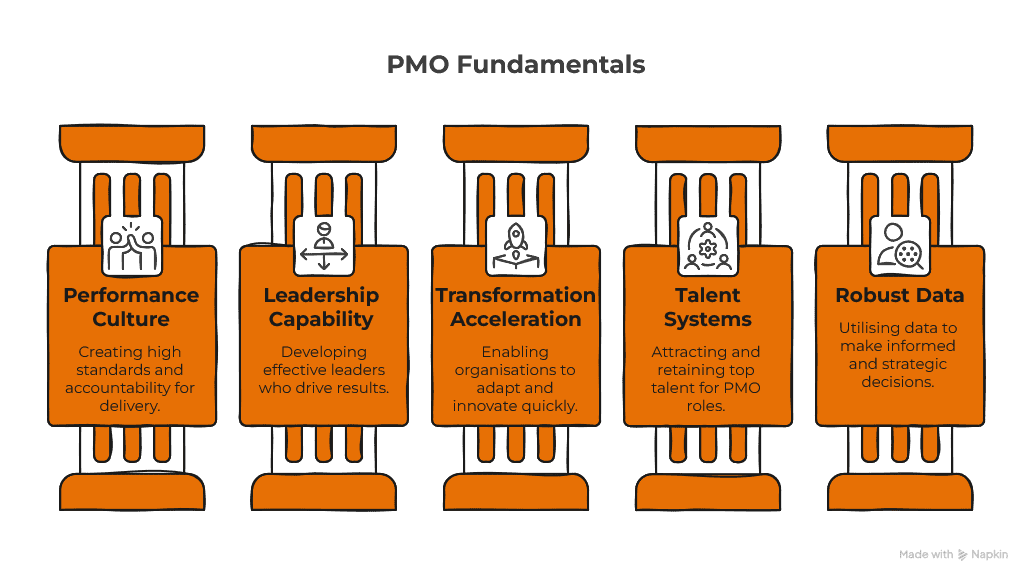
The five fundamentals to focus on (and how PMO can lean in)
Black suggests shifting attention to five fundamentals. Here’s what they can mean for PMO practically.
1) Performance culture
High standards, clear accountability, rapid feedback
- Define ‘good’ (on track, minimum standards for business cases, planning and risk)
- Create quick feedback loops (short governance cycles, fast escalation routes, real-time visibility where possible)
2) Leadership and management capability
P3M Managers and sponsors who deliver, not merely engage
- Coach sponsors on decision-making and prioritisation
- Support P3M Managers with delivery rhythms that actually work
- Help leaders manage by outcomes, not updates
3) Transformation acceleration
Helping organisations learn and adapt faster
- Shorten the gap between ‘we learned something’ and ‘we changed something’
- Use governance for adaptation, not compliance: stop/start/continue, re-prioritise, re-baseline benefits when reality shifts
4) Elite talent systems
Rigorous assessment, attraction and retention
- Be intentional about PMO capability (it’s not admin with meetings) – use the PMO Competency Framework to help
- Define core skills (analysis, insight, influence, delivery knowledge, assurance thinking) and develop them properly
5) Robust data and evidence
Replace opinion with decision-grade information
- Not more data – better insight
- Not vanity metrics – outcome-linked measures
- Clear provenance: where did the number come from, and can we trust it?
Showcasing PMO value: practical moves that actually help
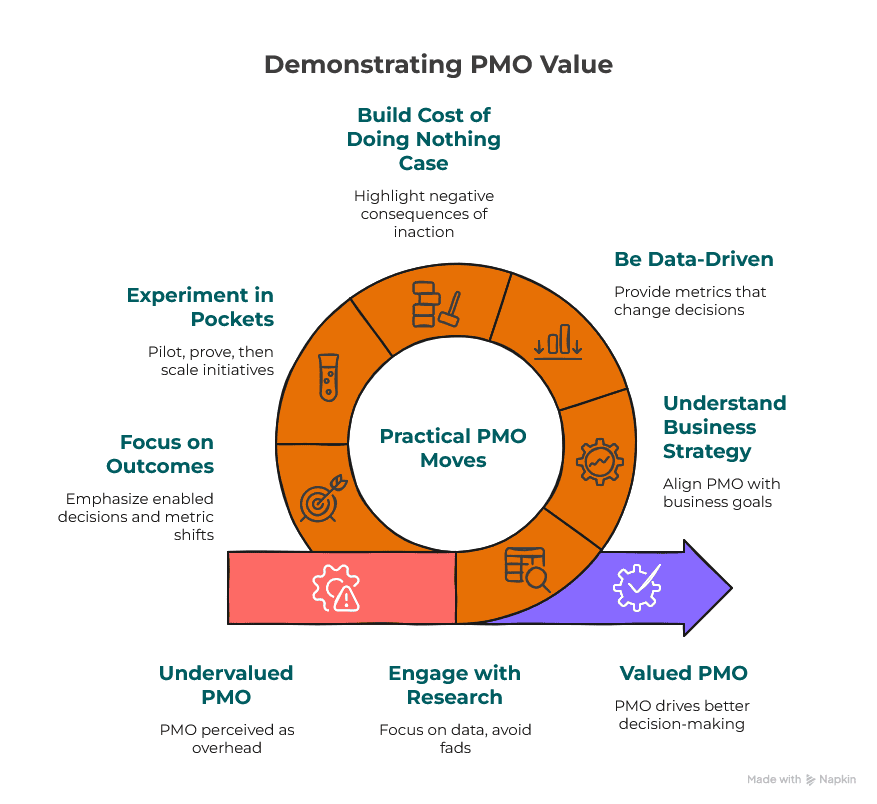
In the same magazine, Katie Jacobs‘ article offered tips for showcasing HR value and they too translate directly into the PMO context. I’ve added some examples to demonstrate.
- Engage with research and evidence (avoid fads; focus on what works) – PMO example: ‘We’re simplifying gates because the data shows they add delay, not risk reduction.’
- Understand business strategy and operating model (value lives near real drivers) – PMO example: ‘We design governance around what the business is trying to shift, growth, cost, or risk.’
- Be data-driven and selective (give leaders the metrics that change decisions) – PMO example: ‘One decision pack: forecast variance, top risks, and resourcing pinch points, no vanity charts.’
- Build the ‘cost of doing nothing’ case (late delivery, benefits leakage, resource contention, governance gaps) – PMO example: ‘Every month we delay costs £X / increases exposure by Y, here’s the price of drift.’
- Experiment in pockets (pilot, prove, scale) – PMO example: ‘Pilot in one area for 6 weeks, measure, keep what works, then scale.’
- Focus on outcomes, not activity (“we enabled X decision / shifted Y metric”, not “we produced 12 reports”) – PMO example: ‘We stopped low-value work and freed £400k capacity, not ‘we issued 12 reports’.’
If you want one simple rule:
PMO value is demonstrated when someone makes a better decision because you existed.
A final reflection
So… which of the four fallacies are you most at risk of?
If you’re brave, don’t just answer it yourself, ask your stakeholders:
- Where do we make things easier for you?
- Where do we slow you down?
- Where do we help you make better decisions?
- Where do we create noise?
We’d love to know your reflections and if you find any of the suggestions helpful.
Professional bodies matter!
I’m a paid-up member of the CIPD because I believe in being part of a profession’s best-practice community.
House of PMO is the PMO’s best practice community: we don’t sell membership for membership’s sake, but to provide a place where PMO people can learn, benchmark, build confidence, and stop reinventing the wheel alone.
And the best bit? The value is in the practical stuff:
- resources and tools you can actually use
- events and sessions where you can test your thinking with people who get it
- member content (including articles like this) that helps you reflect and improve
- a community that keeps you sharp in a fast-changing project world
Because PMO can be a lonely job sometimes. And we’re far better when we learn together.