You can find all our articles for Free Members
Shifting from PMO to TMO – A Personal Perspective
 A personal reflection on the emerging role of Transformation Management Offices (TMO), their relationship with the maturing PMO, and their growing significance in helping organisations translate delivery discipline into strategic alignment, outcome assurance and value realisation.
Shonal Patel is Head of Transformation, EMEA at dentsu international, with a career spanning PMO leadership, portfolio governance and complex organisational change. Having worked in both traditional PMO and emerging TMO environments, Shonal brings a valuable practitioner perspective to the conversation. In this article, she reflects on what changes as a PMO develops into a TMO, what remains essential, and why the shift is less about replacing the PMO and more about building on its discipline.
Why TMOs are Appearing
A new concept seems to be forming, and it is becoming more common across many organisations. As firms face numerous business challenges, there is wide recognition that organisation-wide transformation is non-negotiable. This will become even more important as we enter a new age of digital intelligence, where AI will transform how we work and how clients and consumers engage with products, services and other offerings. Organisations also need to manage their cost base more effectively to remain competitive and profitable. To support this, many are creating what they call Transformation Management Offices, or TMOs.
From my perspective, we are still at the beginning of properly understanding what a TMO does. Many organisations have established their own definition, which can lead to ambiguity. That may sound slightly odd, given how freely TMOs are appearing in some of the most important transformation programmes in medium and large organisations. In almost every job advert I see for a TMO role, one common factor prevails: the ability to work with strategic leaders. But does this really differ from what has traditionally been known as a PMO?
Over the years, I have seen PMOs flex their muscles, moving from project administration to establishing P3O disciplines, managing programmes and projects against strategic outcomes, and driving portfolio management. What I am experiencing now is a shift towards managing specific outcomes in response to changing business conditions, rather than measuring delivery only against strategic priorities.
Strategic priorities are rarely static in today’s business environment. Advances in technology, changing customer expectations, economic volatility, regulatory developments and competitive pressures require organisations to reassess and redefine their strategy continually. Desired business outcomes evolve too, so the organisation can remain relevant, resilient and positioned to achieve its long-term objectives. Where strategic plans once covered three to five years and were reviewed annually, many are now reviewed quarterly or even more frequently. Change portfolios that were once planned with greater certainty are now adjusted more often, requiring a more agile approach to planning, governance and delivery.
PMO Discipline Remains the Foundation
In my experience, people in the TMO work even more closely with CEOs, COOs, CFOs, transformation leaders and executive sponsors. They talk about value, outcomes, benefits, dependencies and organisational alignment in much the same way as portfolio management offices. They also use dashboards, governance forums and spreadsheets to support analysis. What is noticeably different is the level of conversation. It is no longer focused only on status and delivery outputs. It is more about asking, ‘Is this still the right thing to do?’ and ‘Are the outcomes still valid?’ Even so, the TMO profession still feels very young, and organisations are still working out what it means for their business.
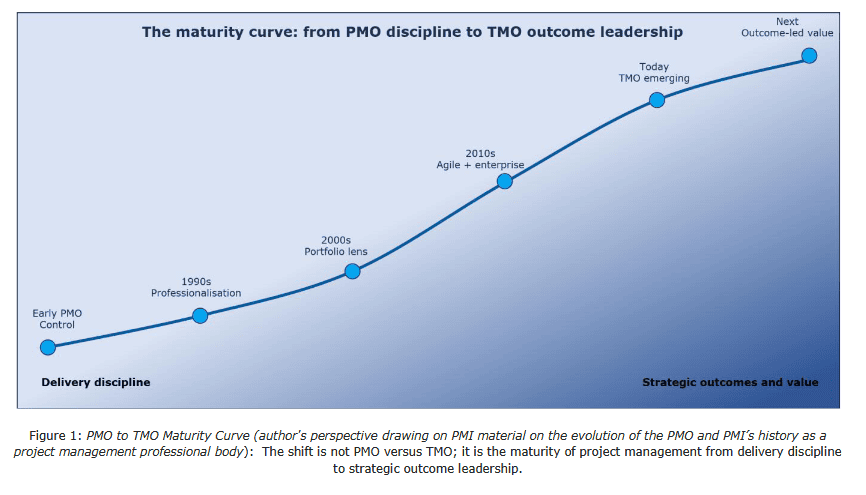
 That is not a criticism, but a note on the journey. To me, the TMO today feels a little like the PMO did when it was becoming a recognised discipline in the 1990s. I set up my first PMO in 1999 for a Y2K programme, and the journey towards an effective TMO feels familiar. Project management had existed long before then, of course, but the 1990s were a period when the PMO began to take on greater professional shape. Standards, methods, certifications and project governance became more established as we moved into the early 2000s. Organisations realised that delivery could not depend purely on enthusiastic project managers and a collective belief that projects could be managed through a lifecycle. The PMO gave structure to complexity, created a common language and helped organisations understand, track, govern and control delivery more consistently.
In many ways, what we have experienced over the past 20 years or so is the PMO growing from infancy into adolescence. It discovered process. It developed standards. It found confidence in RAID logs, milestone plans and steering committee packs. Like most teenagers and young adults, it occasionally became convinced that if everyone simply followed its approach, the world would be a better place. To be fair, sometimes it was right. The discipline that came with the PMO was, and still is, incredibly valuable. It helped professionalise delivery, gave organisations better visibility and created the conditions for more predictable execution.
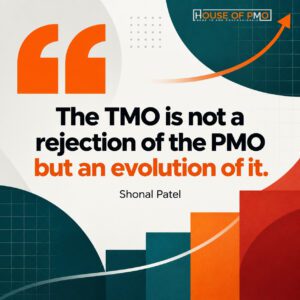
As the PMO grew up, the question changed. It was no longer enough to ask whether the plan was being followed. The more important question became whether the plan was still the right one. That is where I think the TMO is establishing itself. In my view, the TMO is not a rejection of the PMO but an evolution of it. It builds on the discipline of project and portfolio management, but asks it to operate more strategically and with greater agility. Delivery assurance is not an end in itself. The TMO asks whether the organisation is moving towards the outcomes it has committed to achieve and whether it is being enabled to remain competitive.
What Changes in a TMO
When I moved into TMO work, I initially assumed it would feel familiar. In some ways, it did. There were plans, milestones, governance meetings, actions, decisions, risks and dependencies. There were still moments when someone asked for an update five minutes before a key meeting, which is perhaps the one universal constant across all project environments. My PMO instincts were still useful. I knew how to create structure, pull fragmented project governance into a single approach, bring clarity to ambiguous tasks and spot when a milestone was quietly drifting into what I call the ‘optimistic fiction section of the plan’. I knew how to challenge delivery status, connect the dots and spot the watermelon projects from a distance.
What felt different was the purpose of the conversation with senior leaders. The TMO itself is still evolving in my organisation, but I can feel the shift. In a traditional PMO, we might ask, ‘Is the workstream on track?’ In a TMO, the question becomes, ‘Is this workstream still moving the business towards the outcome?’ In a PMO, we ask, ‘Has a key milestone moved?’ In a TMO, we ask, ‘What does that movement mean for value, leadership decisions, operating model readiness, financial impact or shareholder confidence?’ On paper, the difference can look subtle, even obvious. In reality, the whole nature of the conversation has changed.
 Take RAG status as an example. In a PMO role, I would track it and, when projects reported green, the assumption would be that all was well. In a TMO role, we have moved the conversation on: ‘That is good, but are we on track to achieve the intended business outcome?’ The word ‘intended’ matters. It means what the transformation has signed up to deliver, not merely what now looks likely to happen. The project status needs to tell us whether the activity is changing the business in the intended way.
A green RAG status can be comforting, but it is not the same as assessing the intended value of the change. A programme can be busy, well governed and apparently under control while still failing to move the dial on the required business outcomes. The TMO has to be willing to challenge that. It needs to ask whether outcomes are progressing, whether benefits are credible, whether the right decisions are being made, and whether the plan is integrated enough to reveal the consequences of delay, duplication, constraints or misalignment.
Connecting the Whole Transformation
This is why integrated planning is such a core TMO capability. Transformation does not respect the neat boxes we put around workstreams. Technology depends on people change. People change depends on communications. Communications depend on leadership alignment, and leadership alignment depends on decisions made across the organisation. Finance wants to know whether value is materialising. Organisational teams want to know what is expected of them. Senior leaders want to understand where to intervene. Meanwhile, a traditional PMO may still be standing in the corner asking whether everyone has updated their RAID logs. That is no longer sufficient.
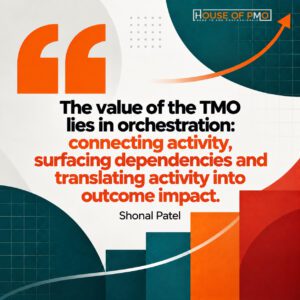
The real challenge, and the real value a well-functioning TMO can bring, is to connect all of this. It is part air traffic control, part orchestra conductor and, on certain days, part organisational therapist, in my experience anyway. The role is not to own every workstream or become the delivery manager. The value of the TMO lies in orchestration: connecting horizontal and vertical activity, surfacing dependencies, translating activity into outcome impact, and helping leaders understand where their decisions are needed to protect or accelerate value.
This is also where the relationship with senior leaders feels different from traditional PMO work. A PMO provides confidence that delivery is being managed. A TMO needs to provide confidence that the transformation is still strategically coherent. The conversations become less about asking leaders to note progress and more about helping them make choices and remove blockages. What should be prioritised? What trade-offs are emerging? Which issue needs executive intervention? Where is value at risk? What happens if one part of the plan moves but the rest does not? The TMO must turn the complexity of transformation into insight that supports decisions.
What the Shift Means for PMO Practitioners
 For PMO practitioners, this shift can be both exciting and uncomfortable. The familiar skills still matter enormously. Structured thinking, planning discipline, governance, risk management, dependency tracking and stakeholder management are all essential. A TMO without PMO discipline can quickly become a strategy conversation with no grip. A TMO that applies only PMO discipline, however, can become a sophisticated reporting function, producing elegant slides that describe a transformation rather than helping to move it forward.
The shift is one of maturity. PMO practitioners moving into TMO roles do not need to abandon what they know. They need to broaden their focus, become more commercially curious, grow more comfortable with ambiguity and feel more confident asking whether the organisation is focused on the right outcomes. They need to understand value as well as delivery. They need to see the connection between milestones and shareholder confidence, between integrated planning and operating performance, and between governance and strategic decision-making.
In my firm, this feels particularly relevant because the role of the TMO is not simply to assure delivery from a distance. It supports strategic outcomes, creates alignment across workstreams, clusters and functions, keeps transformation effort connected to company goals, and helps leadership focus on the interventions that will unlock value. The TMO should not become another layer of bureaucracy. It should help the organisation make better decisions, sooner.
Still Learning What a TMO Can Be
My honest view is that we are still learning what a TMO is, and that is exactly what makes it exciting. If the PMO gave project management its discipline, the TMO is now asking project management to grow into strategic leadership. It is the move from adolescence to adulthood: from control to judgement, from reporting to insight, from activity to outcomes, and from delivery confidence to value confidence.
The best TMOs will not replace PMOs. They will build on them, taking the rigour of project management and applying it to the harder question every organisation now faces: are we simply delivering change, or are we truly transforming?
You can connect with Shonal here >>
Continue Reading
>> Strategic Portfolio Management: Connecting Strategy to Delivery Through the PMO
Continue exploring how PMOs can move beyond delivery activity and help the organisation turn strategy into action.
>> The PMO Ecosystem: Changing and Evolving to Deliver Your Business Needs
Explore why PMOs cannot remain static and how they can evolve alongside the organisation’s needs and maturity.
>> Benefits Management: A Thinking Tool for the PMO
Discover how benefits thinking helps PMOs look beyond delivery status and focus on measurable business outcomes.