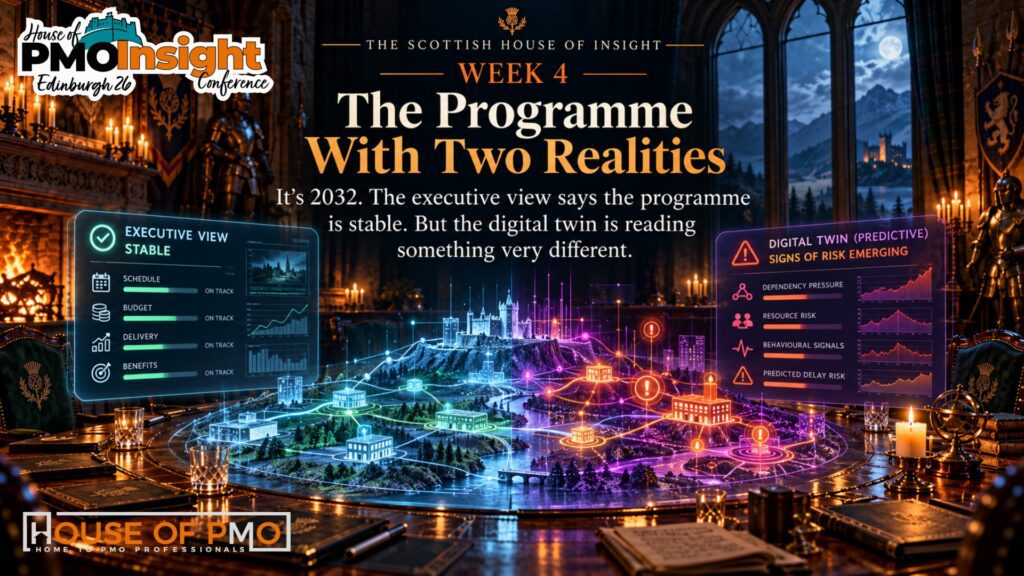
 Week Four has arrived at The Scottish House of Insight and it’s the final week of PMO mystery!
It’s the year 2032 and the executive view says the programme is stable. Delivery confidence is holding, milestones are on track and sponsor confidence is high.
But the programme’s digital twin is reading something very different.
The Programme With Two Realities begins here.
Look closer.
Week Four: The Programme With Two Realities
Take in the overall picture being presented.
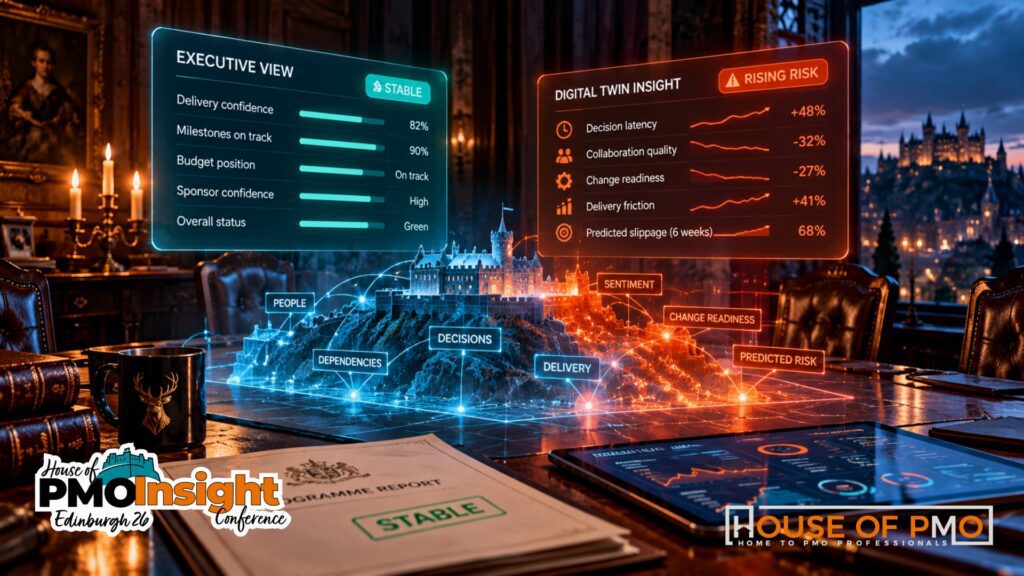
The official report still looks reassuring.
But underneath it, the digital twin is picking up a very different pattern:
decision latency is rising, collaboration is weakening, change readiness is falling and predicted slippage is increasing.
Nothing has failed yet.
So which version of the programme should the PMO trust?
Now it’s your turn.
You’ve seen the executive view.
You’ve seen what the digital twin is detecting.
What should the PMO challenge first?
Choose the answer you think best reflects what the PMO should do next, then submit your response to enter the final Week 4 draw.
Look closer. Make your call.
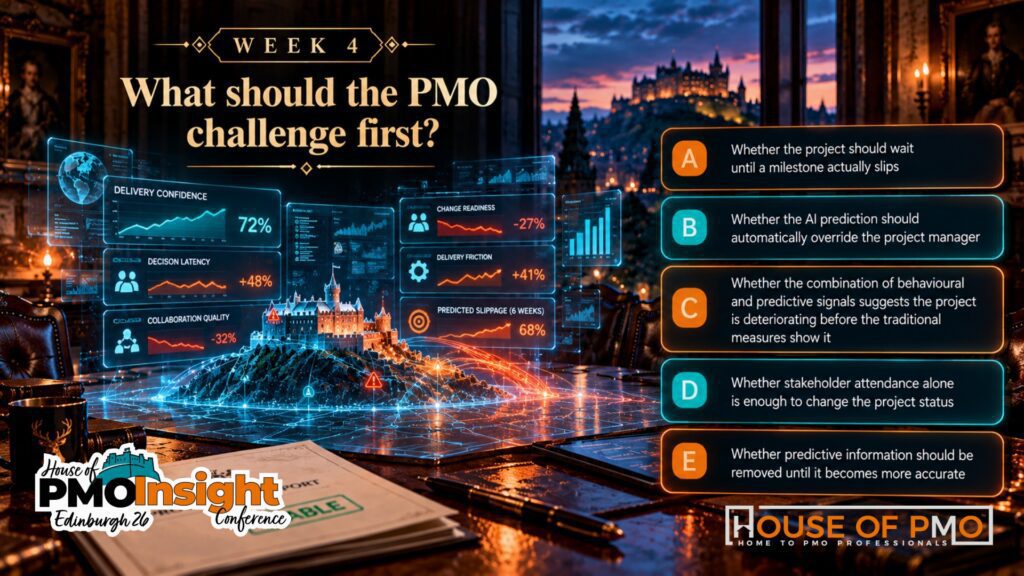
So what would you have entered if the competition was still open?
The answer was C
Whether the combination of behavioural and predictive signals suggests the project is deteriorating before the traditional measures show it.
That is the important distinction in this case, the traditional measures are not necessarily wrong, they are simply telling us what has happened, or what is visible right now.
The digital twin is doing something different. It is looking for patterns across multiple signals and asking whether those patterns point to a problem that has not yet appeared in the usual status measures.
That does not mean the PMO should blindly accept whatever the AI says, it means the PMO should investigate.
If decision-making is slowing, collaboration is weakening, change readiness is falling and delivery friction is increasing at the same time, that combination is worth challenging even if the milestone plan is still green.
The role of the PMO is not to wait for the programme to turn red before asking questions, it is to understand whether the evidence is starting to tell us something earlier.
Why not the other answers?
A. Wait until a milestone actually slips
By then, the PMO has moved from early warning to reporting what has already happened. The value of predictive information is that it gives us the opportunity to investigate before the impact becomes visible in the traditional measures.
B. Let the AI prediction automatically override the project manager
The opposite extreme is no better. Predictive models should inform judgement, not replace it. Human context, experience and challenge are still essential.
D. Use stakeholder attendance alone to change the project status
Attendance might be one useful signal, but it would not be strong enough on its own. The important part of this case is the pattern created by several different indicators moving together.
E. Remove the predictive information until it becomes more accurate
Predictive information will rarely be perfect. The question is not whether it can guarantee the future, but whether it provides useful evidence that helps the PMO ask better questions and make better decisions.
The bigger lesson
Week Four was deliberately set in 2032, but the underlying challenge is already with us.
As PMOs start to use more AI, predictive analytics and behavioural data, we are likely to have access to signals that move before our traditional reporting does – that creates a new challenge.
When the official report says one thing and the emerging pattern says another, the PMO needs to know how to challenge both. Not to trust the machine automatically and not to dismiss it automatically but to combine data, context and human judgement to work out what really deserves attention.
That is where the PMO starts moving beyond reporting and towards genuine insight.
The report says one thing – the pattern says another.
Sometimes the most valuable question is the one we ask before anything has gone wrong.
Look closer.