
 Week Three has arrived at The Scottish House of Insight.
Take a look to be in the running for a PMO Insight Conference ticket in Edinburgh
This week we move away from dashboards and data points and into something far more human: decision-making.
A steering meeting ends, nobody objects, the chair summarises the decision and the minutes record it as agreed. On paper, everything looks settled. But afterwards, concerns begin to surface. So this week’s question is simple: did everyone really agree, or did silence get mistaken for consensus?
Welcome to The Decision Everyone Agreed With.
Look closer.
Week Three: The Decision Everyone Agreed With
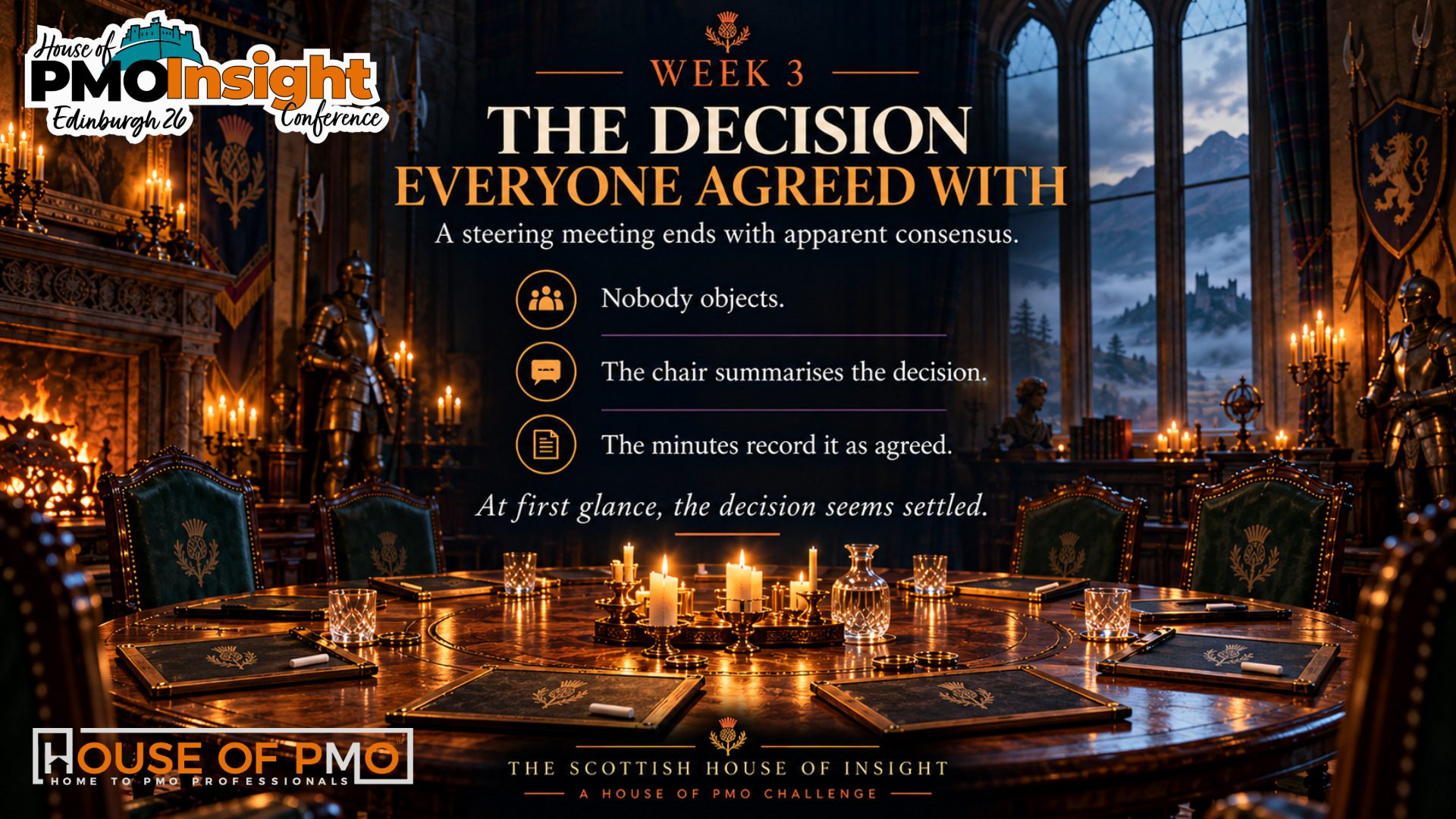
Take in the overall picture being presented.
Don’t decide yet!
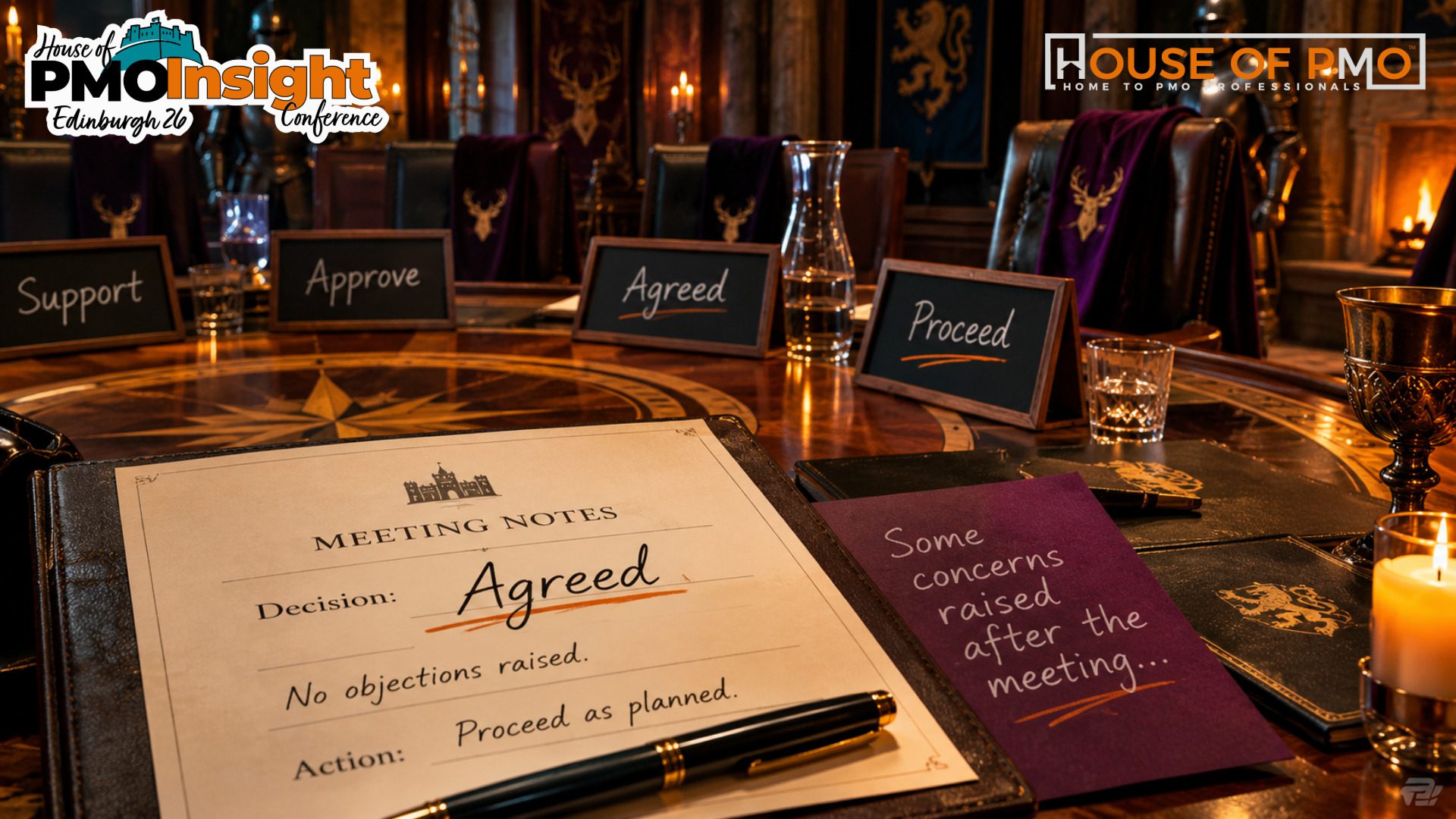
Read the extra evidence carefully.
Ask yourself what this new detail changes about the original conclusion.
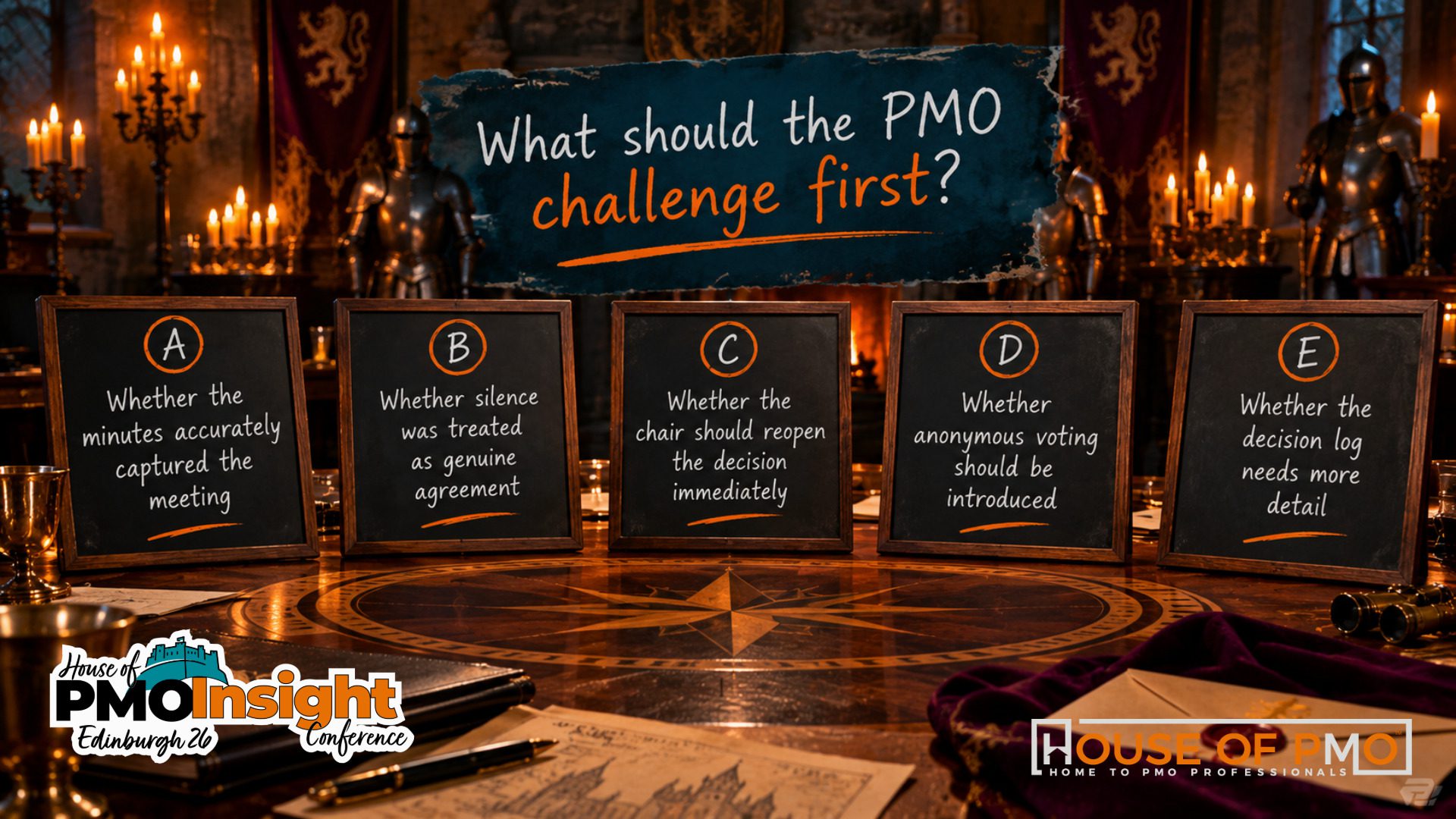
The answer was B
Whether silence was treated as genuine agreement.
This is one of those situations that feels very familiar if you spend enough time around governance meetings.
Nobody says no.
Nobody challenges the recommendation.
The chair asks if everyone is happy to proceed and there is a bit of nodding, perhaps a few people looking down at their notes, and then the meeting moves on.
The minutes say Agreed.
But was it?
That is the bit the PMO needs to be curious about.
Silence can mean agreement, of course. But it can also mean uncertainty, reluctance, hierarchy, lack of confidence, not wanting to be the awkward one in the room, or simply deciding that this is not the moment to have the argument.
And once the word “agreed” appears in the minutes, all of that disappears.
The interesting bit is not the minute but the commitment behind it.
The PMO does not need to start treating every quiet meeting as suspicious, or assume that every decision needs another round of debate – that would be exhausting.
The challenge is knowing when apparent consensus is strong enough to rely on.
If people leave the room and immediately start expressing doubts privately, that tells us something useful. Not necessarily that the decision was wrong, but that the level of commitment may not have been what the meeting record suggests.
There is a big difference between:
“Nobody objected.”
and
“Everyone genuinely supported this and is prepared to act on it.”
Those two things can look remarkably similar in a set of minutes.
What about the other answers?
A. Whether the minutes accurately captured the meeting
They may have done. If nobody objected in the room, then “Agreed” might be a perfectly accurate record of what happened.
The bigger question is whether what happened in the room reflected what people actually thought.
C. Whether the chair should reopen the decision immediately
Possibly, but that comes later.
First, the PMO needs to understand whether there is a genuine issue with the level of agreement and how significant those concerns are.
D. Whether anonymous voting should be introduced
That might help in some situations, but it is a fairly big solution to jump to before understanding the problem.
This is less about introducing another governance mechanism and more about understanding the dynamics already happening in the room.
E. Whether the decision log needs more detail
More detail is not necessarily the answer either.
You can have a beautifully maintained decision log and still have a room full of people who did not really agree.
The wider PMO point
This week’s case moved away from data and dashboards and into something much more human.
Because good decision-making is not only about having the right information in front of people. It is also about what happens when those people come together to make a choice.
- Who speaks?
- Who stays quiet?
- Who feels able to challenge?
- And what are we assuming when nobody does?
For PMOs, that matters because we are often right in the middle of these moments. We organise the governance, capture the decisions, record the actions and help move things forward.
That gives us a useful vantage point.
Not to police the room.
Not to second-guess every decision.
But to notice when the recorded version of events might be tidier than the reality underneath it.
Sometimes the most useful PMO question is not:
“Was the decision recorded?”
It is:
“Did we really agree?”
Look closer.





“Minutes” … I’m sad that this is still the highest discipline form of documentation for many teams.
Well yes *sigh* one day. . . .