 A PMO dashboard can look very convincing, with everything neatly presented, the traffic lights behaving themselves, trend arrows heading in the right direction and perhaps even an AI-generated summary explaining that delivery confidence remains broadly positive.
The problem is that a dashboard which looks polished is not necessarily a dashboard which can be trusted, because what we see on the screen is only the final presentation of information that may have passed through several systems, people and processes before reaching us.
Before we use that information to make decisions, we need to have some confidence that the data behind it is accurate, complete, consistent and current, and that we understand enough about how it has been produced to know what the dashboard is really telling us.
As reporting becomes increasingly automated, this becomes more important because it is very easy to concentrate on the finished dashboard and forget about everything that happened to the information before it reached that point.
This is where the PMO has an important role to play, not only in producing reports and dashboards but also in understanding, checking and challenging the information which sits behind them.
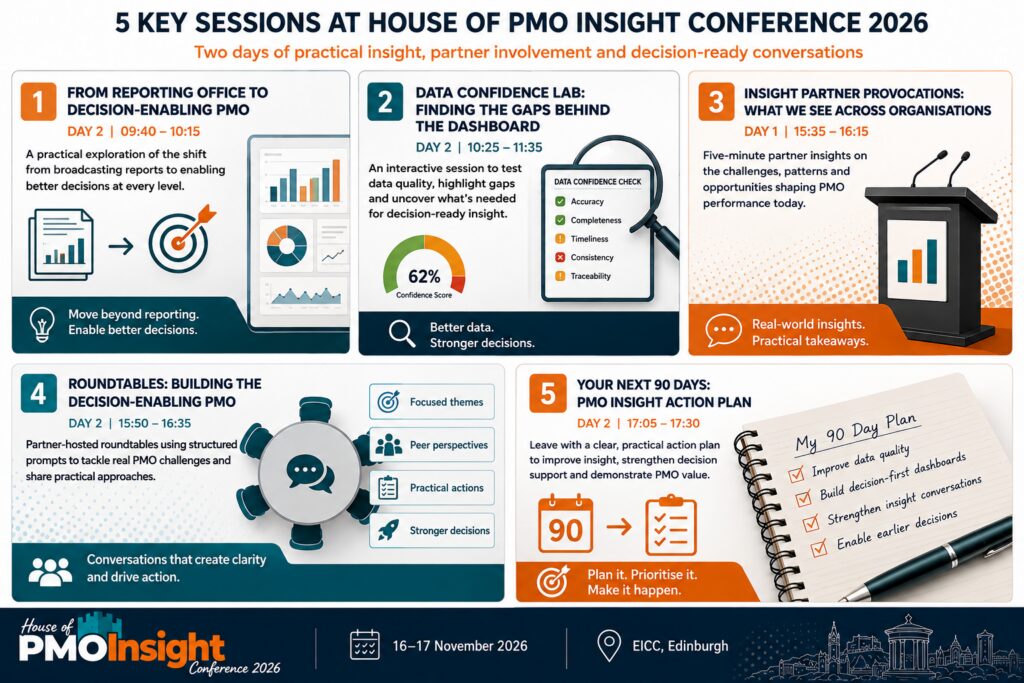
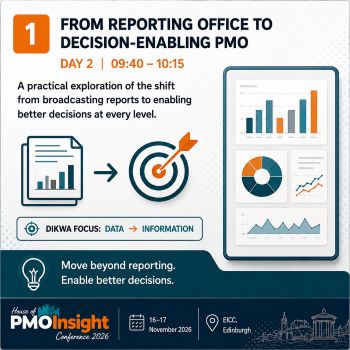
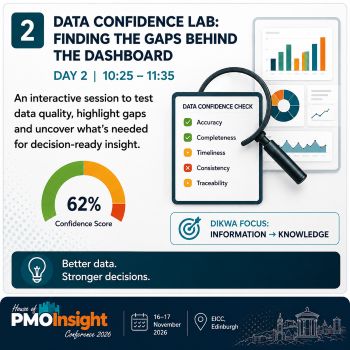
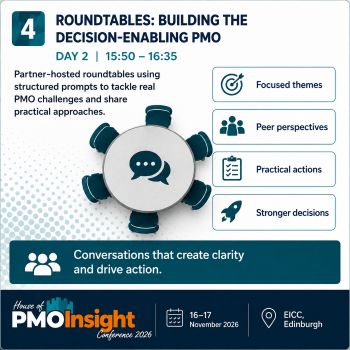
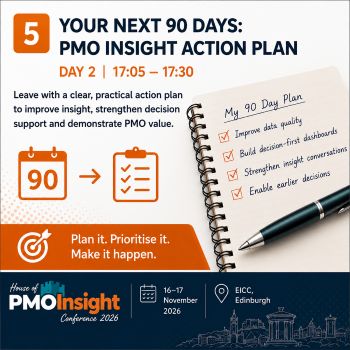
That’s just one of the sessions at this year’s PMO Insight Conference in Edinburgh [16th and 17th November 2026]
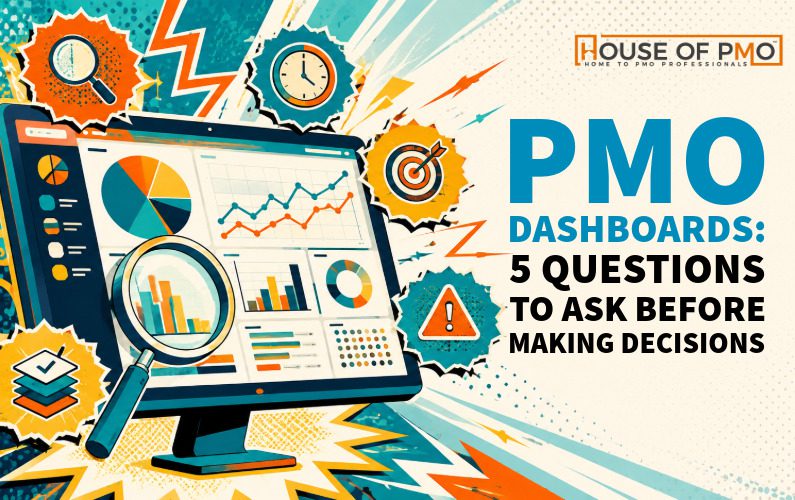
Before accepting what a dashboard is telling us, there are five questions worth asking.
1. Where did the data come from, and who owns it?
 It sounds like a simple question, but understanding where the information originally came from is an important part of deciding whether we can trust it.
The data might have come directly from a project management system, it might have been manually entered by a project manager, it might have come from a spreadsheet which was originally populated from another source, or it might be information which has been combined from several different systems across the organisation.
None of these approaches is automatically a problem, but what matters is understanding the original source, who owns the information and what has happened to it between leaving that source and appearing on the dashboard.
For example, imagine the dashboard tells us that a programme has 14 open risks, which appears to be a straightforward factual piece of information until we start asking where that figure actually came from.
Which system contains the official risk register, who is responsible for keeping it up to date, when was it last reviewed, and was the figure taken directly from that register or copied into another report before eventually appearing on the dashboard?
The further information moves away from its original source, and the more manual intervention there has been along the way, the greater the opportunity for errors, duplication, inconsistent definitions or figures which appear precise but are actually being interpreted differently by different people.
The PMO should therefore understand where important dashboard information originates, who owns it and what transformations, calculations or manual steps have taken place before it reaches the final report.
2. How current is the information?
A dashboard can contain information which is completely accurate and still be misleading if that information is no longer current enough to reflect what is actually happening.
A project might be showing green because the status was last updated three weeks ago, yet since then a supplier may have missed a delivery, a key resource may have left the project, an important dependency may have slipped or a decision may have been delayed.
The dashboard is not necessarily wrong in that situation; it is simply describing a version of the project which no longer exists.
This becomes particularly important where formal reporting cycles do not match the speed at which the delivery environment is changing, because a monthly portfolio report may be perfectly acceptable in one organisation but far too slow in another where significant decisions and changes are taking place every week.
The PMO therefore needs to pay attention not only to what the dashboard says but also to when the information was last reviewed, updated or challenged, particularly when senior leaders are relying on it to make decisions.
Even something as simple as showing when the data was extracted or when the status was last confirmed can help people understand the context in which they should interpret the information.
The question is therefore not simply, Is this number correct?, but also, Is it current enough for the decision we are about to make?
3. What decision is this information helping us make?
 PMOs have traditionally produced a lot of reports, some because people genuinely need the information they contain and others because the report has always been produced and nobody has really stopped to question whether it is still useful.
Before deciding what should appear on a dashboard, it is therefore useful to understand what decisions the audience needs to make and what information would genuinely help them make those decisions well.
For example, a senior leadership team may need to decide whether a project should continue to receive funding, whether additional resources are required, whether a risk needs escalating or whether priorities across the portfolio need to change.
Once we understand those decisions, it becomes easier to determine which information, measures and indicators actually matter.
Without that connection to decision-making, it is very easy to fall into the familiar reporting trap of measuring what is easy to count rather than what is genuinely useful, which means we can produce impressive figures for milestones completed, actions closed, reports submitted or projects currently showing green while still failing to understand whether the organisation is achieving the outcomes and benefits it expected.
All of those measures may be correct and they may have a place in the dashboard, but they should not become a substitute for understanding whether the work itself is delivering what it was intended to deliver.
Good PMO reporting is therefore not about putting as much information as possible onto a dashboard; it is about providing the right information to help people understand what is happening, what requires attention and what decision needs to be made next.

4. What assumptions are behind the numbers?
Not everything we see on a dashboard is a fact, even when the information is presented as a very precise number, date or percentage.
Forecast completion dates, confidence ratings, expected benefits, future costs and capacity forecasts will normally contain assumptions about what is likely to happen in the future, including assumptions about resource availability, supplier performance, dependencies, productivity levels and how quickly risks or issues will be resolved.
 There is nothing wrong with making assumptions because projects, programmes and portfolios could not be planned without them, but problems begin when those assumptions disappear from view and the forecast begins to be treated as though it were simply a fact.
Imagine, for example, that a programme is forecasting completion in November, which looks like a straightforward date on the dashboard but may actually depend on three specialist resources being available from September.
If those resources have not yet been confirmed, then the November date is based partly on an assumption, and understanding that changes how much confidence we should place in the forecast.
A useful question for the PMO is therefore: What happens if this assumption turns out to be wrong?
If the answer is that the cost, delivery date, expected benefits, risk exposure or an important decision could change, then that assumption deserves attention rather than remaining hidden inside the forecast.
Assumptions should also be reviewed as delivery progresses because some will eventually be confirmed as facts, some will no longer apply and others will become risks or issues which need to be actively managed.
Recording an assumption at the beginning of a project is useful, but leaving it untouched for the remainder of the delivery lifecycle is unlikely to help anyone make better decisions.
5. Does the dashboard match what people are experiencing?
Another useful way of testing whether a dashboard reflects reality is to compare what the formal reporting is telling us with what people involved in delivery are actually experiencing.
If every project on a portfolio dashboard is showing green while project teams are talking about overloaded resources, delayed decisions, unresolved dependencies and constant firefighting, there is clearly something worth investigating.
That does not automatically mean the dashboard is wrong, but it does suggest that part of the story may be missing or that the reporting criteria are not capturing what is happening on the ground.
Perhaps project managers are reluctant to report amber or red, perhaps problems have emerged since the last reporting point, perhaps individual measures are technically correct but together create a misleading picture, or perhaps the reporting framework focuses heavily on schedule and cost while overlooking other important indicators of delivery health.
This is where PMO judgement and constructive challenge become important because the role is not simply to collect information, place it into a report and send it to stakeholders.
The PMO should also be looking for gaps, inconsistencies, unusual patterns and areas where the formal reporting does not seem to match the reality being described elsewhere, and then asking the questions needed to understand why.
Dashboards should support conversations rather than replace them, and one of the most useful things a PMO can do is notice when the formal reporting and the lived experience of delivery are beginning to drift apart.
What does AI change?
 AI will make some parts of PMO reporting much easier because it can summarise large amounts of information, identify patterns, highlight exceptions, generate commentary and help turn raw data into polished dashboards far more quickly than traditional reporting processes.
That is useful, but it also makes all five of the questions above more important rather than less important.
If poor, incomplete or outdated information is fed into an AI-enabled reporting process, we can simply create a poor report more quickly, and the finished output may actually appear more convincing because the presentation, wording and analysis look polished and authoritative.
PMO professionals do not need to become data scientists to deal with this, but they do need to understand enough about the information they are using to ask sensible questions about where it came from, how current it is, what assumptions are involved, whether something looks unusual and whether the conclusion being presented actually makes sense.
These are not entirely new skills for PMO professionals because the same thinking is already used when reviewing plans, risks, business cases, forecasts and progress reports.
What AI changes is the speed and scale at which information can now be processed and presented, which makes it even more important that the human judgement surrounding that information remains strong.
The PMO’s role in reporting
 Producing the dashboard is only one part of the PMO reporting service, because much of the value comes from what happens before, during and after the report itself is created.
The PMO brings together information from different areas of the delivery environment, checks it, compares it with other sources, looks for information which does not make sense, asks questions, provides constructive challenge and helps stakeholders understand what the information means in the context of the wider portfolio.
Most importantly, the PMO helps people use that information to make better decisions rather than simply providing them with more data.
As more of the production work involved in reporting becomes automated, the ability to understand, interpret and challenge information is likely to become more important, not less.
A good-looking dashboard is useful, but a dashboard which decision-makers can genuinely trust is much more valuable.
Perhaps the most important question a PMO can ask before a report reaches the people who will act on it is therefore still one of the simplest:
Do we trust this information enough to make a decision with it?
Sources and further reading
- House of PMO (2025), PMO Competency Framework, 3rd edition. In particular, the competences covering Reporting, Insights and Analysis, Risk Management and Assurance, including the validation and interpretation of data, investigating anomalies and omissions, and applying scrutiny and challenge.
- House of PMO (2020), PMO Service Catalogue. See particularly Rollup Reporting, Provision of Management Dashboards and Risk Management Monitoring. The catalogue covers designing dashboards around the decisions customers need to make, sourcing the right information, checking reporting anomalies, challenging RAG status, monitoring assumptions and maintaining data quality and integrity.
- House of PMO (2025), AI: Effective Use in the PMO – Introduction Session. Explores AI in PMO decision-making, automated dashboards, data quality, critical thinking and the continuing importance of human judgement when using AI-generated information and insights.
- House of PMO (2025), How the PMO Can Aid Progress Through the Use of Assumptions. Explores how assumptions support decision-making where uncertainty exists, why assumptions should be recorded and understood, and the relationship between assumptions and risk.
The House of PMO Insight Conference 2026
If this article has given you food for thought about your own PMO’s approach to reporting, data and decision-making, take a look at the Edinburgh based conference coming up in November this year. We’re getting into some of the themes explored in this article and more! Check out the two-day programme for more information. [Tickets now available]