Three pieces of research and one big question
There has never been a shortage of data in most PMOs and, if anything, the problem has been going the other way for some time. We have project and portfolio management tools producing more data, dashboards making it easier to present it and, increasingly, AI giving us new ways to analyse, summarise and make sense of it.
 At the same time, the projects and programmes we support aren’t getting any simpler.
Three pieces of research published this year caught my attention because, although they look at different aspects of project delivery, there is a connection between them.
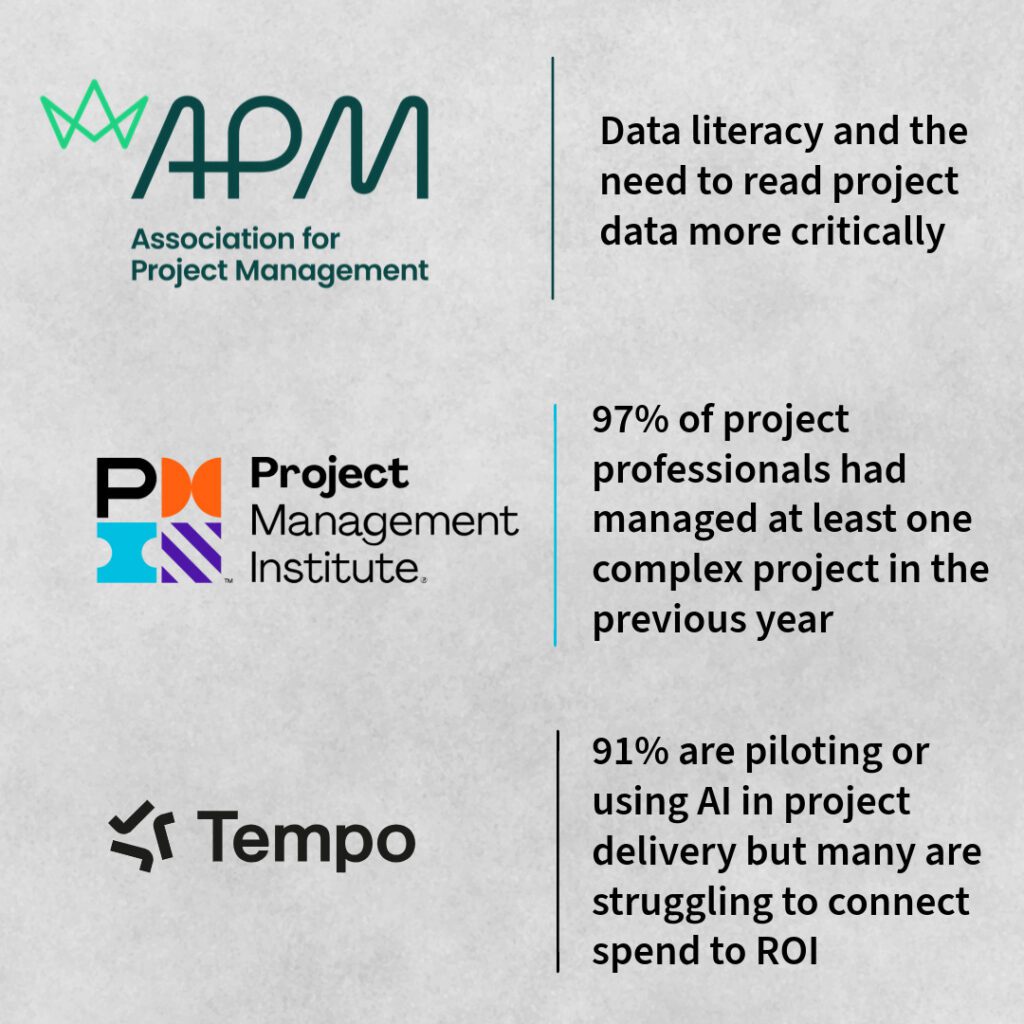
APM* has recently been looking at data literacy and the need for project professionals to read project data more critically, particularly as AI becomes part of how that data is analysed and presented. One of the points made is that greater access to project data doesn’t necessarily lead to better decisions; understanding what the data can and cannot tell us remains important.
PMI’s Pulse of the Profession 2026** looks at the issue from a different direction, focusing on the increasing complexity of projects. It found that 97% of project professionals had managed at least one complex project in the previous year, with 81% saying that projects have become more complex in recent years.
Then there is Tempo’s 2026 State of AI in Portfolio Management Report***, which found that 91% of the 300 senior project, portfolio and PMO leaders surveyed were either piloting or actively using AI in project delivery. At the same time, 42% were struggling to connect AI spend to ROI and 46% reported duplication of work involving AI.
Put those three things together and there is an interesting question for the PMO.
If we have more data available to us, increasingly sophisticated technology to help us work with it, and more complex delivery environments to navigate, are we actually helping people make better decisions?
Producing the information is only part of the job of the PMO. What happens between that information being produced and someone being able to confidently make a decision from it is where a lot of the real PMO work takes place.

More Data Doesn’t Necessarily Mean More Actionable Information
 Most PMOs will recognise the amount of effort that goes into reporting- information is collected from projects and programmes, checked, consolidated and presented through dashboards, portfolio reports, governance packs and different views designed for different stakeholders.
The difficulty comes when we assume that because something has been turned into a dashboard, graph or RAG status, it has somehow become more reliable. We looked at this recently in [PMO Dashboards: 5 Questions to Ask Before Making Decisions], particularly the questions PMOs should be asking about the information sitting behind the dashboard. There are still questions about where the original data came from, how current it is, whether definitions have been applied consistently and what might be missing. There are also judgements being made by different people as the information moves from its original source through to the final report.
Take something as familiar as an Amber project status. What does Amber actually mean in that organisation and has the same definition been applied across every project? Is the Project Manager making the assessment against agreed thresholds, or is there an element of optimism or caution involved? Has something significant happened since the information was submitted which changes the picture?
The recent APM article on data literacy makes a useful distinction here because being data literate isn’t simply about being able to read the dashboard. It also means understanding what the data can and cannot tell us, where assumptions have been made and what questions the available data wasn’t designed to answer.
For the PMO, therefore, the question isn’t just whether we have the data; we also need to understand it well enough, and have sufficient confidence in it, to use it to support better decision making.
Understanding the Complexity Behind the Data
The challenge becomes greater when we put that reporting environment into the context highlighted by PMI’s research. Complexity is no longer something experienced only by particularly large projects and programmes, with 97% of the project professionals in PMI’s research having managed at least one complex project in the previous year.
 That complexity can come from many different places, including dependencies between projects, competing priorities, changes in strategy, new technology, suppliers, regulation, stakeholders with different objectives and teams working across different functions and locations.
A natural response to increasing complexity is to want more information about it, which can lead to more fields being added to reports, additional measures, more detailed dashboards and more frequent updates. Sometimes that additional information will be useful, but there is also a danger that we simply transfer the complexity from the project environment into the reporting environment.
A senior decision-maker doesn’t necessarily need the PMO to pass all of that complexity upwards. They need help understanding which parts of it matter to the decision they are being asked to make.
For example, if two programmes are competing for the same specialist resource, a resource utilisation chart can show that the problem exists, but it doesn’t necessarily help someone decide what should happen next. They also need to understand which piece of work has priority, what happens to the other programme if the resource is moved, which milestones or benefits might be affected and whether there are other options available.
This is where the PMO starts to move beyond reporting what is happening and begins to help people understand what that information means in the wider context.
PMI’s research describes the PMO’s role in increasingly complex organisations as an enterprise “execution hub”, helping to align sponsors, govern trade-offs, develop shared understanding and coordinate dependencies. For many PMOs, those activities will already sound familiar; the difference is perhaps in recognising that they are an important part of helping the organisation make better decisions rather than simply additional activities around reporting.
What Does AI Add?
The Tempo research is interesting because 91% of the project, portfolio and PMO leaders surveyed are already piloting or actively using AI, which suggests we’re quickly moving beyond the point where simply using AI is particularly noteworthy. The more useful question for the PMO is what we are actually using it for and whether it is improving the work being carried out.
 There are obvious opportunities within PMO work. AI can help summarise large amounts of information, identify patterns, interrogate data, draft commentary, identify anomalies, explore scenarios and bring together information from different sources. These uses can save time and, importantly, may help us identify something in the information that we might otherwise have missed.
What AI doesn’t do is remove the need to understand the information being used and, in some respects, it makes that understanding even more important. That’s something we explored in [Using AI Is Only the Beginning: Three AI Skills PMO Professionals Need for Better Project Decisions], where we looked at using AI effectively, critically evaluating its output and governing AI-enabled decisions. If an AI tool produces a convincing summary of portfolio performance, someone still needs to know whether the underlying information is reliable. If it identifies a trend, someone needs to decide whether that trend is meaningful in the context of the portfolio and, if it recommends an action, someone needs to understand enough about the situation to challenge that recommendation.
The APM article also makes the point that AI can process poor-quality project data just as easily as good-quality data, potentially amplifying inconsistencies while producing an output which appears confident and convincing. For PMOs, this brings us back to understanding where the information came from, how much confidence we have in it and where professional judgement still needs to be applied.
A useful question here is which parts of the work can technology help us with and where do we still need the knowledge, experience and judgement of the PMO professional?
Starting With the Decision
 One of the simplest ways a PMO can approach this is to start with the decision rather than starting with the report.
Think about a typical governance meeting where there might be a substantial pack containing project status, milestones, risks, finances, resources, dependencies and benefits. Some of that information will be needed because there are decisions to be made, while some will be included because it has always formed part of the reporting pack.
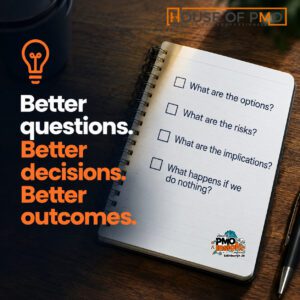
Starting with the decision changes the way we think about the information required. We need to understand what decision needs to be made, what the decision-maker needs to know, what evidence supports the available options, what remains uncertain and what the consequences might be if one option is selected over another. We also need to understand what happens if no decision is made.
The PMO may already have most of the data required to answer those questions; the difference comes from how that data is selected, interpreted and presented. There will also be occasions when the most useful thing the PMO can do is highlight that there isn’t sufficient confidence in the available information to support a decision yet. That in itself is useful insight.
From Information to Action
 There is another part of the process which can sometimes get lost because producing good information is not the end point. The value comes from what happens as a result of the information, the decision that follows and the action subsequently taken.
If a portfolio review identifies that a programme requires intervention, for example, the PMO should also be interested in what is going to happen next, who is responsible, when the action will take place and what outcome is expected. It should also be possible to come back later and understand whether the decision had the intended effect.
This creates an important feedback loop for the PMO because we’re not only learning about the performance of projects and programmes; we’re also learning something about the quality and usefulness of the information being provided to decision-makers.
Over time, the PMO can start to understand which indicators helped identify problems early, which reports resulted in useful action, which information was repeatedly produced but rarely used and where the PMO’s analysis helped someone make a different decision. Equally, there will be occasions where plenty of data was available and something important was still missed, which gives the PMO another opportunity to understand why.
This is all part of improving the service the PMO provides rather than simply improving the report itself.
The Decision-Enabling PMO
Taken together, the recent work from APM, PMI and Tempo paints an interesting picture for the PMO. We have more data and increasingly powerful ways to work with it, while operating in project environments where complexity is increasing and AI is already becoming part of project and portfolio delivery.
The opportunity isn’t necessarily to produce more information. It is to get better at what happens between the data being available and somebody being able to act on it with confidence.
That means making sure the data can be trusted, understanding its limitations, adding the context which isn’t immediately visible, identifying what matters, making dependencies clearer, challenging assumptions and helping decision-makers understand the choices and consequences in front of them.
AI, dashboards, PPM tools and reporting processes can all help with this, but they remain tools which need people around them who are capable of asking good questions, interpreting what they see, recognising what might be missing and being confident enough to challenge when something doesn’t look right.
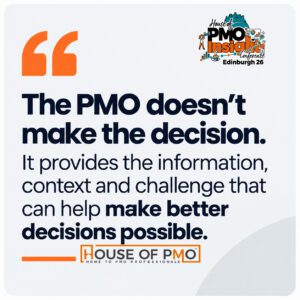
The PMO doesn’t have to make every decision, but it can play a significant role in helping make better decisions possible.
Bringing This to PMO Insight Edinburgh
These are some of the questions we’ve been thinking about while putting together PMO Insight Edinburgh 2026, where the two days follow the journey from data through to information, knowledge, insight, decisions and ultimately action.
We’ll be looking at how PMOs can build confidence in the data they use, what makes information decision-ready, where PMO tools can and cannot help, how AI is being used in practice and what governance needs to sit around it. Just as importantly, we’ll be looking at the human side of all of this: how PMO professionals interpret, question and challenge information before it is used to make decisions.
The intention isn’t to spend two days talking about why better information and decision-making matter; most PMOs already understand that. The focus is on the practical side of how we get better at doing it, with examples, exercises, tools and conversations that can be taken back into the PMO afterwards.
The amount of data available to us isn’t going to reduce, AI isn’t going away and projects are unlikely to suddenly become less complex. The interesting question for PMOs is how we develop the capability to work with all three and turn what we know into better decisions and, ultimately, better action.
PMO Insight Edinburgh 2026 takes place on 16–17 November at the EICC, Edinburgh. [Find out more details]
Sources used in the article:
*APM – Data Literacy: Reading Project Data Critically in the Age of AI [Link]
**PMI – Driving Success in Complex Projects / Pulse of the Profession 2026 [Link]
*** Tempo – 2026 State of AI in Portfolio Management Report [Link]