
 This post comes from The Scottish House of Insight, a four-week challenge we ran in the lead-up to PMO Insight Conference Edinburgh 2026.
Each week, we shared a fictional PMO scenario built around data, reporting, judgement and decision-making. Participants were given the situation, the evidence and a set of possible answers, then asked one question:
What should the PMO challenge first?
The aim was not simply to find a “correct” answer, but to encourage the kind of thinking the conference itself was designed around: looking beyond the headline, testing the evidence and understanding what really matters before a decision is made.
This was the first case in the series: The Portfolio With No Red Projects.
Below, we look at the scenario again, explain why the strongest answer was what it was, and explore the wider PMO lesson behind it.
The Portfolio With No Red Projects
The monthly portfolio report looks reassuring.
There are 18 projects.
14 are Green.
4 are Amber.
None are Red.
92% of milestones are reported as on track.
Portfolio confidence is High.

But one detail in the evidence changes the picture.
Five projects haven’t updated their status for more than six weeks.

So what should the PMO challenge first?
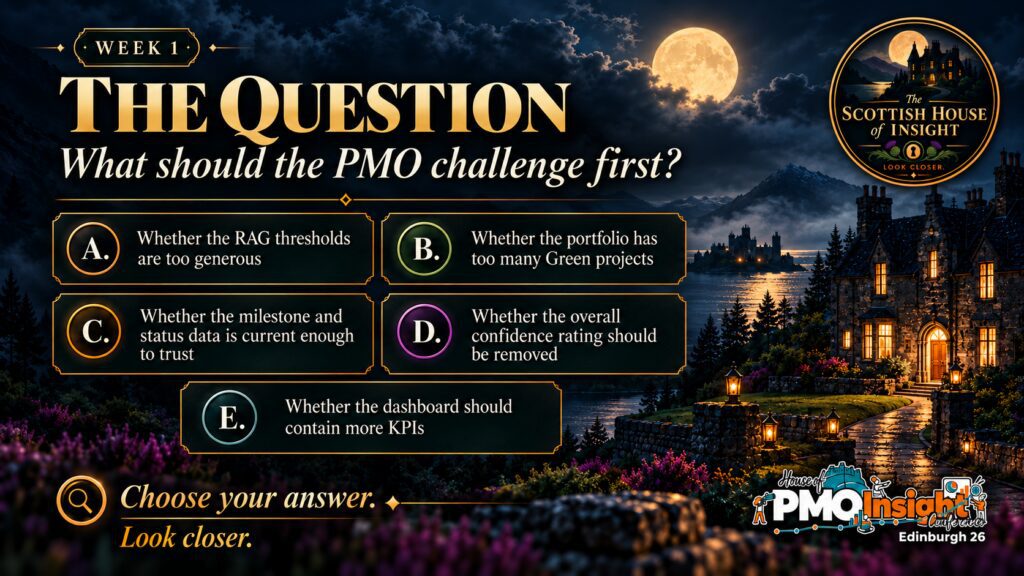
Five projects had not updated their status for more than six weeks
That was the real point of the challenge and the strongest answer was:
C. Whether the milestone and status data is current enough to trust.
Why?
Because before the PMO challenges the thresholds, the number of Green projects, the confidence rating or the amount of information on the dashboard, it first needs to establish whether the evidence underneath the conclusion is reliable.
A project can remain Green on a dashboard long after the reality has changed, a milestone can continue to appear “on track” simply because nobody has updated it and a portfolio can look healthy because the reporting process is still producing numbers, even when some of those numbers are no longer telling us what is happening now.
That does not mean the portfolio is definitely in trouble. It means we do not yet have enough confidence in the evidence to accept the conclusion without challenge.
Good PMO reporting is not just about collecting data and displaying it consistently, it is about understanding whether that data is current, complete and strong enough to support a decision.
In this case, the most important first question was not:
“Why are there no Red projects?”
It was:
“When was this information last true?”
And that is a much more useful PMO question. The role of the PMO is not simply to produce a reassuring dashboard. It is to help decision-makers understand how much confidence they should place in what they are seeing.
That is exactly the kind of thinking we’ll be exploring at PMO Insight Conference Edinburgh 2026: moving beyond reporting towards insight, judgement and decision support.